




Printed circuit board (PCB) field failures are among the costliest issues electronics companies face. A circuit board that performs perfectly in the initial testing process but fails in the field can be catastrophic. Performing design-for-manufacturability (DFM) on the PCB data before production manufacturing begins prevents oversights that could have been prevented early in the product lifecycle.
This blog post breaks down the most common DFM-related contributors to PCB field failures and outlines practical steps to eliminate them. Whether you’re designing high-density consumer electronics or mission-critical industrial equipment, adopting stronger DFM practices is one of the simplest, highest-ROI improvements you can make.
Why DFM Matters for Field Reliability
DFM ensures that your PCB can be built consistently and correctly with standard manufacturing processes and tolerances. When a PCB design doesn’t align with what the fabrication and assembly shops can reliably produce, you end up with:
- Inconsistent solder joints
- Weak copper connections prone to cracking
- Components that drift or detach during thermal cycling
- Latent defects that pass testing but fail in the field
- Higher scrap and rework rates
In other words, poor DFM erodes both reliability and manufacturing yield.

Copper-plated holes placed in SMD devices can rob solder from components, confirming via-in-pad processing is suggested for build integrity.

Common DFM Issues That Lead to Field Failures
Insufficient Annular Ring and Pad Size
Annular ring violations can result in weak or intermittent connections between the component lead and the plated-through hole (PTH). This often leads to failures after mechanical shock or repeated thermal cycling.
Prevention Tips:
- Consult IPC standards for manufacturing rules.
- Follow fabrication house-specific drill tolerance rules.
- Increase pad/annular ring size when possible.
- Use teardrops for high-reliability interconnects.

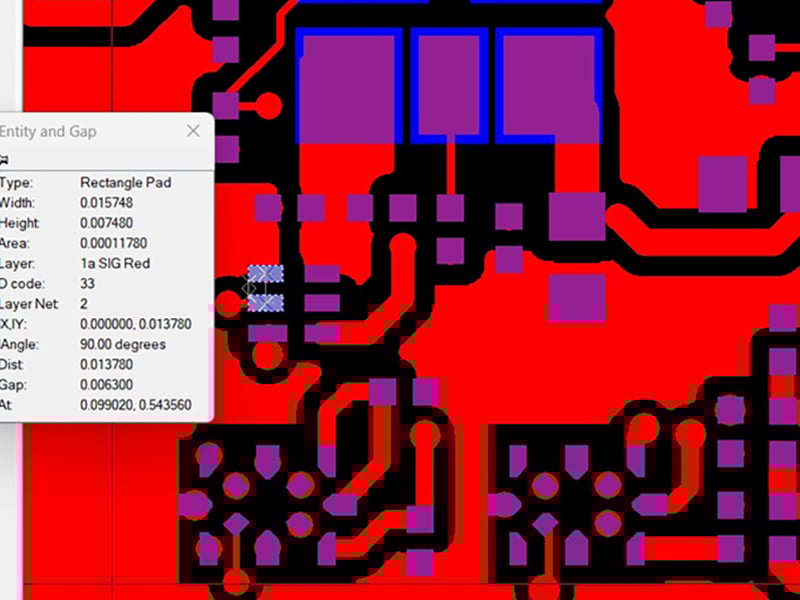
Missing mask pad near a spacing violation on a pad that is technically dead. Randomly, traces can be broken intentionally as well; however, there is no way of knowing without verifying.
Poor Solder Mask Design
Solder mask misregistration is common in high-volume manufacturing. When pad spacing is less than 0.009” copper-to-copper, the remaining solder mask web may be less than 0.004”, increasing the risk of solder bridging, mask loss, and possible shorting during assembly.
Supplying mask with oversized, 1:1, SMD-defined, and odd shapes makes it difficult for production to adhere to the standards.
Prevention Tips:
- Add solder mask dams wherever possible, 0.004” web or greater.
- Ensure mask opening tolerances match the fabricator’s capabilities, 0.006” over the copper size.
- Avoid tightly packed fine-pitch components unless necessary.
- When possible, stick with a green mask as it is consistently used and adheres to the laminate surface.
Inadequate Component and Trace Spacing
Tight component spacing may meet the design requirements but exceed manufacturing capabilities as well as the trace and space of the circuitry. Consult with your PCB supplier about the copper thickness, and what is manufacturable will aid in processing success. During assembly, the pick-and-place machines also have mechanical limits. This leads to skewed placement and solder joints that pass AOI but fail under vibration or stress.
Prevention Tips:
- Respect the minimum keep-out zones and spacing rules for all features.
- Copper weights should be in line with the design.
- Verify spacing against both IPC guidelines and assembly house capabilities.
- Provide adequate room for rework and inspection.
Balancing Data to Prevent Assembly Issues
Use the space on the PCB fully to aid in assembly issue prevention. Keep via pads away from components when space allows; holes draw heat away from components. When pads are on the opposite sides of a component, this can cause them to heat unevenly during reflow, the part can lift (“tombstone”) or create marginal joints that degrade over time.
Prevention Tips:
- Balance copper areas around paired pads.
- Use symmetric pad geometries.
- Consider thermal relief patterns on thermally massive copper areas.
Via-in-Pad Without Proper Fill
Putting vias directly in component pads without filling them can cause solder to wick away during reflow, leading to cold joints and long-term reliability issues. The via in pad process is used more frequently as PCBs shrink in size, although the process increases the cost of the part to be manufactured, it is necessary to prevent other issues.

When using a solderable surface (such as the QFP shown) to transmit a signal, via-in-pad processing should be used for ease of assembly, scrap prevention, and superior product.
Prevention Tips:
- Use filled and plated-over vias (VIPPO) if via-in-pad is used in the design.
- Allow manufacturing to fill all of the vias of the size used in the pads.
- Avoid via-in-pad on high-reliability or high-power components unless absolutely necessary.
Overly Tight Copper Spacing
Copper spacing violations may pass DRC but could still be unmanufacturable at scale. With PCB manufacturing comes process necessities. For copper etch, an increase factor is applied to copper to allow for product reduction. Etching factors decrease spacing in most, if not all, areas of the copper layer. When properly added and reduced in process, the change is not noticed.
Prevention Tips:
- Add margin beyond the bare minimum spacing rules.
- Keep high-voltage spacing in accordance with IPC-2221.
- Consult the fab house for process-specific spacing recommendations by copper weight.
Implementing Better DFM: Practical Steps
Involve Your PCB Manufacturer Early
Bring your circuit board fabrication and assembly partners into the design process early. Their feedback helps you avoid downstream rework and ensures the board is buildable at scale.
Ask Your Supplier for DFM
PCB engineering can process data and provide professional feedback on what they have found within the design. Running these checks before releasing Gerbers can eliminate delays, prototyping, and cost.
Follow IPC Standards
Key references:
- IPC-2221 (general design)
- IPC-7351 (land pattern design)
- IPC-6012 (qualification & performance for rigid boards)
Basing your design on IPC standards ensures that your layout meets manufacturing standards.
Summary
Performing a DFM helps to eliminate PCB manufacturing challenges and field failures. Strengthening your DFM practices by aligning with your trusted supplier and its manufacturing capabilities, following IPC guidelines, and validating designs through the DFM process dramatically reduces the likelihood of costly prototyping, loss of time to production, and to market.
Key Takeaways
- DFM directly impacts field reliability: Designs that ignore fabrication and assembly realities often pass initial testing but fail later due to weak solder joints, cracked copper, or latent defects exposed by thermal cycling and vibration.
- Pad geometry and spacing are foundational to durability: Adequate annular rings, proper trace spacing, and compliant solder mask design reduce the risk of intermittent connections, bridging, and shorts that commonly cause field failures.
- Balanced copper and layout symmetry prevent assembly defects: Uneven copper distribution, poorly placed vias, and asymmetric pads can lead to tombstoning, cold solder joints, and marginal connections that degrade over time.
- Via-in-pad requires the right manufacturing process: When space constraints demand via-in-pad designs, filled and plated-over vias are critical to prevent solder wicking and long-term joint reliability issues.
- Early manufacturer involvement strengthens outcomes: Engaging fabrication and assembly partners early, running formal DFM reviews, and following IPC standards significantly reduce scrap, rework, delays, and unexpected field failures.