



In product development, speed matters. Design teams are under constant pressure to move faster without increasing risk, especially when developing custom cable assemblies that require hard tooling and molded features.
Overmolded cables offer excellent durability, strain relief, sealing, and an aesthetically pleasing finish, but they are often perceived as slow or expensive to develop due to their tooling requirements. This is where modern 3D printing technology has become a powerful ally. By combining additive manufacturing with traditional overmolding processes, engineers can dramatically reduce development timelines while improving design confidence before committing to hard tooling.

What Is 3D Printing and Why It Has Transformed Prototyping
3D printing, also known as additive manufacturing, is the process of creating physical parts directly from digital CAD models by building them layer by layer. For engineering teams, the impact has been enormous. Parts that once required weeks of machining or molding can now be produced in minutes or hours. Material costs are low, the equipment is widely available, and iteration cycles are short. Interestingly, most engineers have hobbyist-grade 3D printing machines that they use at home for problem-solving outside the office.
One of the biggest advantages of 3D printing is accessibility. Engineers can print parts in-house, whether in a lab, office, or even at home. There is no need to wait for outside vendors or minimum order quantities. If a design changes, the updated file can be printed the same day. This speed and flexibility make 3D printing ideal for early-stage R&D, mechanical validation, and stakeholder reviews.
What Is Overmolding and How Overmolded Cables Are Manufactured?
Overmolding is a manufacturing process where a molten thermoplastic is injected around a cable, connector, or subassembly. The result is a unified part that improves strain relief, environmental sealing, abrasion resistance, and overall robustness. Overmolded cable assemblies are widely used in medical devices, automotive systems, industrial controls, consumer electronics, and applications requiring the ability to survive harsh environments.
Traditional overmolding requires precision-machined steel or aluminum tooling. The cable assembly is placed into the mold, the material is injected, and the part is cooled and ejected. While the finished product is highly reliable and cost-effective at scale, the upfront tooling investment and lead time can slow early development.
Common Risks That Make Engineers Hesitate
Despite the benefits, many teams hesitate to choose custom overmolded cables during development. One major concern is tooling cost. Custom molds often cost several thousand dollars and require weeks to design, machine, and validate. Another concern is design risk. If the first molded parts reveal fit issues, sealing problems, or ergonomic concerns, modifying hard tooling can be expensive and time-consuming.
Why 3D Printing Has Changed the Overmolding Development Process
3D printing has fundamentally changed how engineers approach molded components. While it does not replace injection molding for production, it fills a critical gap during development. Engineers can now evaluate form, fit, and assembly interactions long before tooling is launched.
It is important to understand the limitations. A 3D printed part does not behave like a molded thermoplastic or elastomer. Surface finish, sealing performance, flexibility, and durability will not match production materials such as TPE or PVC. For cosmetic validation or true environmental testing, traditional overmolds with hard tooling are still required. However, for many early decisions, a 3D printed part is more than sufficient.
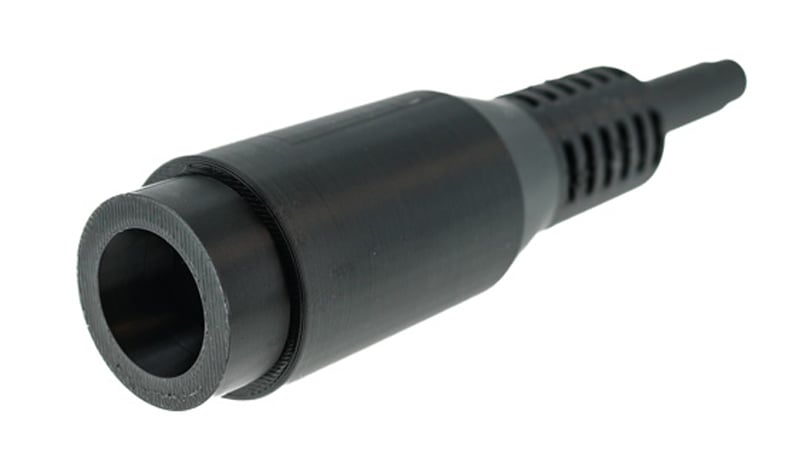
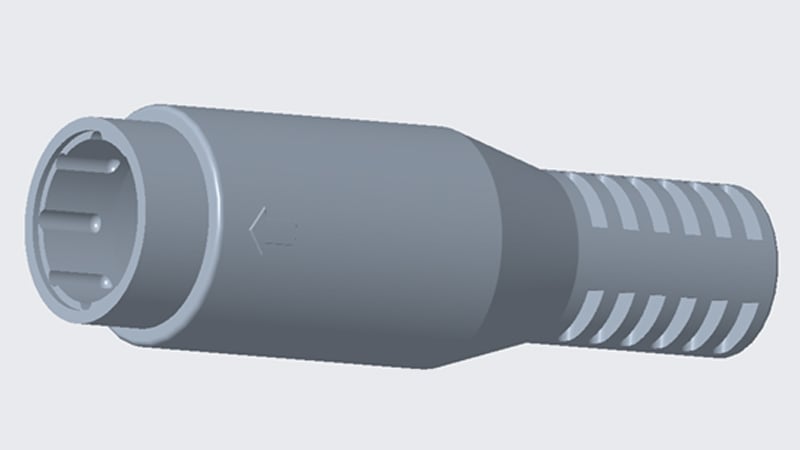
3D printed overmold vs. the CAD model.
Five Ways 3D Printing Accelerates Overmolded Cable Timelines
1. Perform Time-Sensitive Fit Checks
One of the most valuable uses of 3D printed overmolds is performing rapid fit checks. Engineers can verify that an overmold clears housings, aligns with panel cutouts, and provides adequate strain relief clearance before investing in tooling. This alone can prevent costly redesigns.
2. Use 3D Printed Samples to Gain Stakeholder Feedback
3D printed samples are also excellent communication tools. Physical parts make it easier to gain approval from managers, customers, and other stakeholders who may struggle to interpret CAD files. A printed overmold allows marketing, industrial design, and management teams to provide feedback early.
3. Replace an Overmolded Strain Relief with a 3D Printed Member
In some prototype builds, 3D printed components can temporarily replace an overmold or grommet. When mechanical strength, sealing, or flexibility are not critical during early testing, printed parts allow systems to be assembled and evaluated quickly.
4. Build Multiple Variations of a Critical Design Feature
Another major advantage is design iteration. Engineers can print multiple versions of an overmold with different shapes, wall thicknesses, or strain relief features and compare them side by side. This rapid down-selection process leads to better final designs with less risk.
5. Consider a 3D Printed Mold and a Hobbyist-Grade Silicone
For applications that need elastomer-like behavior but cannot justify tooling yet, 3D printing can even be used to create temporary molds. These printed molds can be filled with two-part silicone or potting compounds to create representative overmold samples. While not production-ready, they provide a realistic approximation of flexibility and feel.
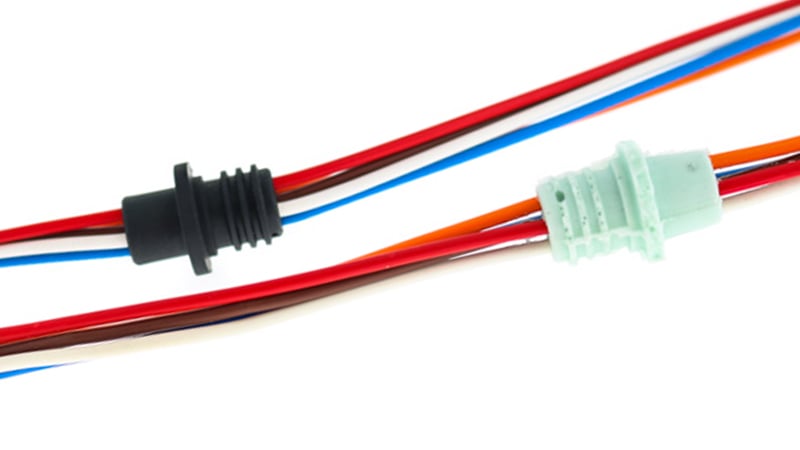
Hard-tooled overmold vs. hobbyist silicone with 3D printed mold.
Where 3D Printing Fits Best in Overmolded Cable Development
The most successful teams treat 3D printing as a bridge, not a replacement. It shortens timelines, reduces uncertainty, and improves collaboration, but it does not eliminate the need for proper tooling and process validation. When used strategically, 3D printing allows engineers to enter the overmold tooling phase with confidence rather than assumptions.
Summary
3D printing has become an essential tool for accelerating the development of overmolded cable assemblies. By enabling rapid fit checks, fast design iteration, and early stakeholder engagement, it reduces risk and shortens timelines before committing to hard tooling.
While it cannot replicate the physical properties of a true molded overmold, it plays a critical role in modern cable assembly development. When combined with experienced engineering and a well-planned transition to production tooling, 3D printing helps teams move faster, make better decisions, and deliver more reliable overmolded cable solutions.
Key Takeaways
- 3D printing allows engineers to rapidly prototype overmold shapes, perform fit checks, and validate designs in hours rather than weeks, reducing early-stage development risk.
- While 3D printed parts do not replicate the mechanical, sealing, or cosmetic performance of true injection-molded overmolds, they are extremely effective for form, fit, and assembly evaluation.
- Using 3D printed overmolds early helps avoid costly tooling rework by identifying clearance issues, strain relief problems, and ergonomic concerns before hard tooling is released.
- 3D printed samples are valuable communication tools, making it easier to gain stakeholder alignment and approval compared to reviewing CAD models alone.
- When used strategically, 3D printing accelerates overmolded cable timelines by complementing, not replacing, traditional injection molding and production validation processes.