




When it comes to modern electronics, space is always at a premium, reliability is paramount, and design decisions can significantly impact product performance. Flexible circuits (flex) and rigid-flex PCBs often sit at the center of these decisions.
At first glance, they may appear interchangeable, and in some applications, either option can be effective. However, choosing between flex and rigid-flex requires a closer look at the design requirements, cost trade-offs, and long-term reliability expectations.
At Epec Engineered Technologies, we work with customers across medical devices, aerospace systems, industrial controls, and consumer electronics who face this exact decision. Let’s break down the strengths and limitations of each approach so you can determine the right fit for your next project.
Why Rigid-Flex Circuit Boards?
Rigid-flex PCBs combine rigid circuit board sections with flexible circuitry into a single, integrated design. Instead of relying on connectors and separate flex cables to bridge boards, rigid-flex allows you to build a continuous, highly reliable interconnect solution.
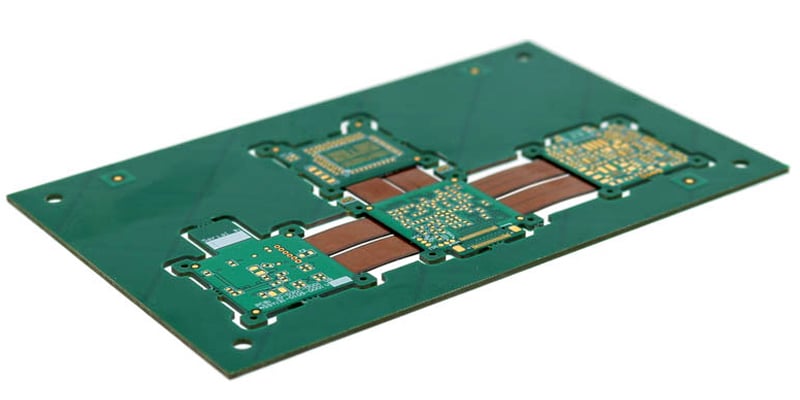
Integrated rigid circuit board sections and flexible circuitry design.
Advantages of Rigid-Flex PCBs
- High reliability: By eliminating connectors and solder joints between rigid and flex circuit boards, rigid-flex reduces potential points of failure. This makes it a go-to choice for mission-critical industries, such as aerospace and medical equipment.
- High-density capability: Rigid-flex circuit boards can easily support layer counts of four or more, accommodating complex routing and impedance control for advanced designs.
- Streamlined assemblies: A rigid-flex assembly replaces what might otherwise be multiple circuit boards connected by cables or flexible circuits and connectors. This simplifies the overall build and can reduce long-term maintenance and points of failure.
Drawbacks of Rigid-Flex PCBs
- Higher cost: More materials, more steps, and specialized manufacturing processes mean rigid-flex is more expensive than standalone flexible circuits.
- Longer lead times: The manufacturing process is more complex and can take easily twice as long, if not longer, which can extend production schedules.
- Added weight: While still lighter than adding connectors and cables, rigid-flex is typically heavier than a pure flex solution.
- Design complexity: Factors like via placement, shielding, and stack-up strategies are more challenging. For instance, via placement to interface distance becomes critical, and shielding can only be done by copper layers in rigid sections.
Why Flex Circuits?
Flexible circuits consist solely of flexible substrates like polyimide, which allows the finished assembly to bend, fold, or wrap within the mechanical design of the product.
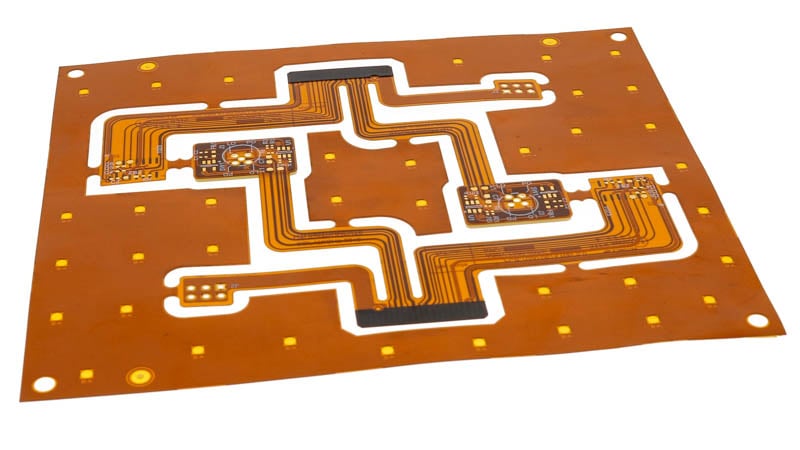
Polyimide flexible circuit in an array.
Advantages of Flex Circuits
- Lightweight: With no rigid material outside of optional stiffeners, flex circuits keep assemblies thin and featherlight.
- Lower cost: Flex PCBs are generally less expensive than rigid-flex when the design requirements are modest.
- Faster lead times: With fewer processing steps, production is quicker than rigid-flex PCBs, making flex a good choice for time-sensitive projects.
- Custom stiffness where needed: Stiffeners can be applied to support components without sacrificing flexibility in other areas.
- Shielding options: Flex can use copper layers or specialized shield films to address EMI concerns.
Drawbacks of Flex Circuits
- Assembly considerations: If multiple flex circuits are required to connect different parts of a system, the overall assembly cost can increase.
- Layer count limitations: Flex circuits typically max out around four layers before flexibility is severely reduced.
- Material limitations: PCB designers have fewer options for substrate materials compared to rigid PCBs.
- Coverlay challenges: Openings in coverlay are harder to define than soldermask, and stiffeners cannot adhere directly to soldermask. These issues sometimes require additional design tweaks.
Overlapping Applications
In some projects, either flex or rigid-flex could be used effectively. For instance, both can support impedance-controlled designs, handle EMI shielding, and reduce the use of mechanical connectors. The decision often comes down to the balance between cost, reliability, and design complexity.
If a design requires high reliability, it must reduce interconnect points or support a dense stack-up; rigid-flex will likely be the better option. On the other hand, if the focus is on lightweight, lower-cost, and quick-turn requirements, flex may be the smarter choice.
How to Choose Between Flex and Rigid-Flex
The right decision always comes back to your assembly requirements and end-use environment. Consider:
- Reliability expectations: Will the product operate in critical environments such as aerospace, military, or medical equipment?
- Layer and density needs: Do you need four or more layers or fine-pitch routing?
- Cost and timeline constraints: Is budget a primary factor, or is reliability worth the added cost?
- Weight sensitivity: Is minimizing the mass critical, as in wearable devices or UAVs?
- Shielding requirements: Will EMI performance drive the design?
Summary
At Epec, we don’t just manufacture flex and rigid-flex PCBs. We collaborate with engineers from the earliest design stages. With decades of experience across thousands of applications, we can evaluate your design intent and recommend whether flex or rigid-flex is the best fit. Our engineering team also provides DFM reviews to ensure your design is manufacturable within the desired cost, weight, and performance envelope.
Whether you’re building next-gen medical diagnostic equipment, aerospace controls, or consumer electronics, having a partner who understands both the technical nuances and the business trade-offs makes all the difference.
Key Takeaways
- Rigid-flex PCBs provide high reliability and eliminate connector points but increase cost, lead time, and weight.
- Flex circuits are lighter, faster to produce, and cost-effective, but face limits in layer counts and assembly considerations.
- Shielding, impedance control, and reliability requirements are key drivers in deciding between flex and rigid-flex.
- The decision should always be based on assembly requirements, operating environment, and product lifecycle goals.
- Partnering with an experienced manufacturer like Epec ensures your design is optimized for both performance and manufacturability.