



Walk outside and look around. Chances are you will interact with several human-to-machine electronic interfaces before the day is over. You may use the keypad at a gas station, enter a code on a garage door opener, check a trail camera in the woods, or navigate using a chartplotter multifunction display (MFD) on a boat.
While these products serve very different purposes, they all share a common challenge: they must continue operating reliably despite exposure to weather, moisture, dirt, and temperature extremes, all with the need for constant use.
Designing user interfaces for marine and outdoor equipment requires far more than simply placing buttons on a product. Engineers must carefully consider environmental conditions, sealing methods, materials, testing requirements, and long-term reliability. A user interface that works perfectly in a laboratory may quickly fail if exposed to salt spray, humidity, ultraviolet light, or repeated water intrusion. Understanding these challenges early in the design process can help prevent costly redesigns and improve product performance throughout its lifecycle.
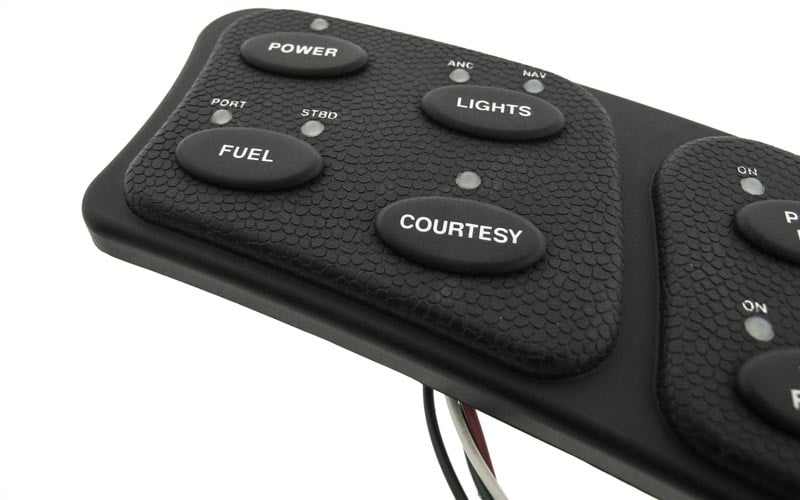
User interface keypad used in a marine application.
Common Human-Machine Interfaces Used Outdoors
Any electronic device intended for outdoor use or operation near water requires special consideration during development. Human-machine interfaces (HMIs) are particularly important because they serve as the primary connection between the user and the device. Water and dust can be especially troublesome to certain types of buttons and switches that are to be used outdoors.
Examples of outdoor and marine user interfaces and common switch technologies include:
| Application | Keypad Technology |
|---|---|
| Fuel pump and kiosk keypads | Capacitive touch switches |
| Tactile switches | |
| Garage door access systems | Membrane switches |
| Silicone elastomer keypads | |
| MFDs and marine chartplotters | Touchscreen displays |
| Silicone elastomer keypads | |
| Cellular trail cameras | Membrane switches |
| Silicone elastomer keypads | |
| Outdoor industrial control panels | Capacitive touch switches |
| Tactile switches | |
| Recreational vehicle controls | Rubber boots |
| Tactile switches | |
| Agricultural equipment displays | Touchscreen displays |
| Tactile switches |
Regardless of the application, these interfaces must continue functioning even when exposed directly to rain, spray, condensation, dust, mud, or humidity.
Buttons and touchscreens often need to operate while wet. Water cannot be allowed to penetrate the housing or button assembly and reach the internal electronics. Even small amounts of moisture intrusion can lead to corrosion, intermittent operation, or complete failure over time. Water can also inhibit the proper function of certain types of touchscreens and capacitive touch switches since the wet surface interferes with the active touch sensing circuitry.
The Environmental Challenges of Marine and Outdoor Applications
Outdoor electronics face some of the most demanding operating environments encountered in commercial products. Because these conditions rarely occur independently, engineers must design for multiple environmental stressors simultaneously.
Salt exposure is among the most destructive conditions. Marine environments constantly expose equipment to airborne salt particles and saltwater spray. Salt accelerates corrosion, attacks exposed metal surfaces, and can degrade electrical connections if proper protection is not incorporated into the design. Environmental testing such as salt-fog can help screen units and assess their resilience to high concentrations of salt exposure.
Direct sunlight presents another challenge. Extended UV exposure can discolor materials, weaken plastics, degrade adhesives, and reduce the lifespan of display components. Sun exposure can also cause increased temperatures and exacerbate high temperatures due to the additional heat load.
Temperature extremes must also be considered. Outdoor equipment may experience freezing winter temperatures followed by intense summer heat. These temperature swings can cause expansion and contraction of materials, stress seals and adhesives, and impact display performance. Condensation cycles within a sealed volume can further create moisture issues within sealed regions of electronic devices.
Water exposure is often the most obvious challenge. Rain, splashing water, washdowns, and accidental immersion can all occur depending on the application.
Certain outdoor environments may also introduce fungal growth concerns. Warm, humid conditions can support biological growth that degrades materials and affects long-term reliability. This is especially concerning for certain types of polymers and elastomers that promote fungal growth.
Understanding IP Ratings for Outdoor User Interfaces
Ingress Protection (IP) ratings are commonly used to define how well an enclosure resists dust and water intrusion.

IP65
An IP65-rated product provides complete protection against dust ingress and protection against water jets projected from any direction. Testing typically involves spraying water at controlled pressures and flow rates while verifying that no harmful water intrusion occurs.
Many outdoor control panels, industrial keypads, and membrane switches are designed to meet IP65 requirements.
IP67
An IP67 rating includes complete dust protection and adds temporary immersion protection. To achieve IP67, the device must withstand immersion in water at a specified depth of about one meter and duration of up to 30 minutes without allowing harmful water ingress or causing a malfunction.
Products exposed to occasional submersion or severe weather conditions often target this rating.
IP68
IP68 represents one of the highest commonly specified protection levels. The exact immersion depth and duration are typically defined by the manufacturer and application requirements.
Marine electronics, underwater monitoring equipment, and highly ruggedized outdoor products frequently utilize IP68-rated designs.
While achieving a higher IP rating generally improves environmental protection, it also increases design complexity. Gasket selection, enclosure design, cable sealing, and assembly processes become increasingly important.
MIL-STD-810 Resilience for Harsh Environments
Many outdoor and military-adjacent products also undergo testing based on MIL-STD-810.
MIL-STD-810 is a U.S. military environmental testing standard that evaluates how equipment performs under challenging conditions such as vibration, shock, humidity, salt fog, temperature cycling, solar radiation, rain, and dust exposure.
While not every commercial product requires MIL-STD-810 qualification, the standard provides valuable guidance for evaluating the durability of keypads, displays, membrane switches, and other user interface products intended for harsh environments.
Testing to these conditions can reveal weaknesses that may not be obvious during normal laboratory evaluations.
Design and Assembly Best Practices for Improving Reliability
One of the most effective ways to improve durability is through conformal coating of the printed circuit board assembly (PCBA). Conformal coatings create a protective barrier over sensitive electronics, helping protect against moisture, corrosion, and contaminants. Conformal coating can be sprayed or painted onto the entire PCBA or specific regions of the circuit board.
Material selection is equally important. Outdoor-rated plastics, UV-resistant overlays, corrosion-resistant metals, and marine-grade elastomers should be considered whenever environmental exposure is expected.
Proper sealing is another critical design element. Gaskets, O-rings, compression seals, and molded silicone features help prevent water and dust from reaching sensitive electronics. Silicone boots and elastomeric sealing features are also commonly used around buttons, switches, and connectors to improve ingress protection without affecting usability. Silicone keypads remain a popular choice because they provide excellent environmental sealing while maintaining tactile feedback. Special ribs can be hard-tooled and molded into the silicone keypads or other members to help provide an improved sealing surface when compressed.
Additional protection can be achieved using RTV sealants, potting compounds, and encapsulation materials. These materials provide another layer of environmental protection while helping secure components against vibration and shock.
Modern touchscreens can be engineered to operate with wet or damp fingers. This capability is especially important for marine electronics, handheld devices, and equipment used during adverse weather conditions. The exact design changes are centered around the microcontroller and the way the circuit and software/firmware interrogate the capacitive touch switch.
Membrane switches frequently incorporate internal gasket layers as part of their construction. These gaskets help create additional environmental barriers while maintaining a low-profile design.
The best solution often depends on the operating environment, user expectations, and overall system requirements.
Addressing Harsh Environments Early in Development
One of the biggest mistakes engineers make is treating environmental protection as an afterthought.
Many sealing features, material choices, and enclosure designs must be incorporated early in the development process. Waiting until the design is nearly complete often limits available options and increases development costs.
The first step is clearly defining the actual use case. Will the device be exposed to rain, washdowns, salt spray, immersion, dust, or temperature extremes? How long must it survive under those conditions? Should it remain fully operational during exposure or simply recover afterward? What specific industry specifications and standards must the device be qualified to?
These questions help establish realistic design targets.
It is also important to plan for at least one design iteration. Environmental testing frequently reveals opportunities for improvement, even in well-designed products.
Finally, third-party testing should be considered whenever environmental performance is critical. Independent testing provides confidence that the product can withstand real-world conditions before it reaches customers.
Summary
Designing user interfaces and keypads for marine and outdoor equipment requires balancing usability, reliability, and environmental protection. Whether the product uses a touchscreen, silicone keypad, membrane switch, or combination of technologies, the interface must continue functioning despite exposure to moisture, salt, sunlight, temperature extremes, and physical abuse.
By selecting appropriate materials, incorporating proven sealing methods, designing for environmental protection early, and validating performance through testing, engineers can significantly improve the long-term reliability of outdoor user interfaces. In harsh environments, success is not determined by how a product performs on the day it ships. It is determined by how well it continues to perform years later after repeated exposure to the elements.
Key Takeaways
- Marine and outdoor user interfaces must be designed to withstand water, humidity, UV exposure, temperature extremes, dust, and corrosion while maintaining reliable operation.
- Common outdoor interface technologies include touchscreens, membrane switches, silicone keypads, tactile switches, and elastomeric sealing provisions.
- IP65, IP67, and IP68 ratings help define a product's resistance to dust and water ingress, making them important benchmarks when designing for harsh environments.
- Reliability can be significantly improved through conformal coating, outdoor-rated materials, gaskets, O-rings, RTV sealants, potting compounds, and silicone sealing features.
- Environmental requirements should be addressed early in the design process and validated through testing, as many sealing and durability features are difficult or costly to add later in development.