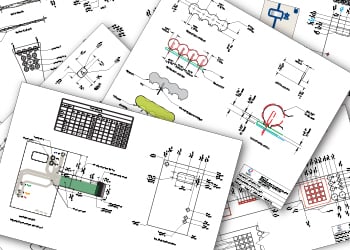




From a PCB manufacturing perspective, designing for testability focuses on ensuring the circuit board can be efficiently inspected and verified at scale without slowing down production or increasing costs.
Manufacturers rely on clear access to critical nodes, consistent pad geometries, and well-defined test points that accommodate automated test equipment such as flying probe and bed-of-nails fixtures. Proper spacing, labeling, and panelization strategies also play a key role in enabling optical inspection and electrical testing processes to run reliably.
By aligning the design with manufacturing test requirements early on, engineers help minimize yield loss, reduce rework, and streamline the transition from fabrication to fully tested assemblies.
When to Engage PCB Manufacturing
Designers should be thinking about manufacturing from the very beginning of the PCB design process, not after the layout is complete. Decisions made during schematic capture and early component selection, such as package types, component availability, and layer stack-up, have a direct impact on fabrication complexity, assembly yield, and cost. As the design progresses into layout, considerations like trace widths, spacing, via structures, and panelization should align with the capabilities and constraints of the intended manufacturer.
Waiting until the end to address manufacturability often leads to costly redesigns, delays, or performance compromises. Instead, involving manufacturing considerations early, and ideally collaborating with fabrication and assembly partners during the design phase, helps ensure the board can be produced reliably, tested efficiently, and scaled without unexpected issues.
Click here to view a larger image.
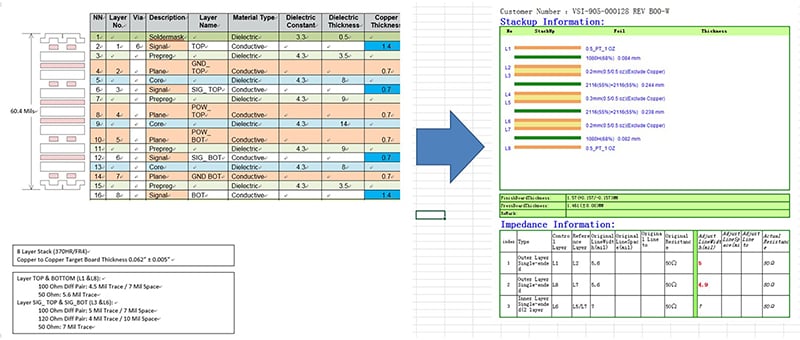
Often, a supplied stack-up can add cost, increase lead time, and not benefit the final product. We will always suggest the best fit for our customers and manufacturing.
How Manufacturing Can Aid in Design
Manufacturing can significantly aid the PCB design process by providing early feedback on what is practical, reliable, and cost-effective to manufacture at scale. Fabricators and assemblers bring insight into process capabilities, such as minimum trace widths, drill tolerances, layer stack-ups, and material choices, which help designers avoid pushing beyond realistic limits. This guidance reduces the risk of redesigning and ensures the layout aligns with standard production processes.
They also help optimize component selection and placement by advising on package availability, soldering constraints, and assembly methods. For example, manufacturers can recommend footprint adjustments, spacing improvements, or orientation changes that improve automated placement and solder joint reliability. In addition, they can suggest design-for-test features like accessible test points and panelization strategies that integrate smoothly with inspection and test equipment.
By collaborating early and throughout the design cycle, manufacturing partners help streamline the transition from prototype to production, improve yields, lower costs, and reduce time to market.
There are several ways your PCB supplier can assist in your projects prior to finalizing your data package. A PCB stack-up, for example, refers to the arrangement and configuration of the layers that make up a printed circuit board, including conductive copper layers and insulating dielectric materials. It defines how many layers the board has, the order in which they are placed, and the thickness and material properties of each layer.
In a typical stack-up, copper layers are used for signal routing, power, and ground planes, while dielectric layers provide electrical insulation and mechanical support. The stack-up determines critical electrical characteristics such as impedance control, signal integrity, and electromagnetic performance, as well as mechanical properties like board thickness and rigidity.
Designing an appropriate stack-up is essential for ensuring the PCB performs as intended and can be manufactured reliably. It often involves collaboration with the manufacturer to select standard materials, control layer symmetry, and meet fabrication constraints, especially for high-speed or high-frequency designs. Your production team can save costs by using common stock that meets the values desired in impedance and overall thickness.

Legend applied to the solder surface as shown in green, or mask undersized at plated slot area could pose a problem at assembly.
DFM
Design for Manufacturing (DFM) review is a structured evaluation of a circuit board design to ensure it can be fabricated and assembled reliably, efficiently, and at an acceptable cost. Typically performed by the manufacturer, or in collaboration with the design team, this review checks the layout against real-world production capabilities and process limits before the board is released to fabrication.

During a DFM review, key aspects such as trace widths and spacing, drill sizes, annular rings, solder mask clearances, silkscreen placement, and layer stack-up are analyzed to identify potential issues. It also examines component footprints, placement density, and orientation to ensure compatibility with automated assembly processes like pick-and-place and reflow soldering. Panelization, fiducial placement, and test point accessibility may also be reviewed to support efficient manufacturing and inspection.
The goal of a DFM review is to catch problems early, before they result in fabrication defects, assembly failures, or costly delays, allowing designers to make adjustments that improve yield, reduce rework, and ensure a smoother transition into production.

During DFM, mask issues are common. As supplied, the mask is undersized, allowing mask to remain on soldering surfaces.
Panelization
PCB manufacturers can suggest the best array (panelization) layout by leveraging their knowledge of fabrication processes, assembly equipment, and handling requirements to optimize both yield and efficiency. Rather than leaving panel design entirely to the PCB designer, manufacturers analyze the board’s size, shape, and component placement to determine how multiple units should be arranged on a production panel.

They consider factors such as panel size standards, spacing between boards, and the most suitable depanelization method, whether that’s V-scoring, tab-routing, or a combination of both. Based on this, they can recommend the ideal orientation of each board within the panel to minimize material waste and ensure mechanical stability during assembly. They also evaluate where to place breakaway tabs, tooling holes, and fiducials so automated equipment can accurately align, assemble, and inspect the circuit boards.
Additionally, manufacturers assess component overhangs, edge clearances, and stress-sensitive parts to prevent damage during depanelization. By proposing an optimized array layout, they help improve throughput, reduce scrap, and ensure the boards move smoothly through fabrication, assembly, and test processes.
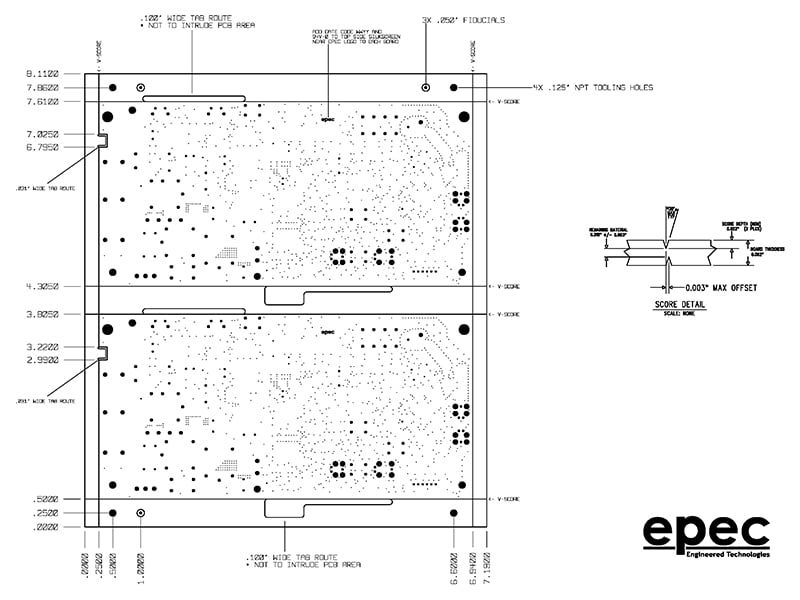
PCB manufacturing often proposes an array. At Epec, we will draft and propose the array while considering the final assembly as well.
Summary
Effective PCB design depends on early and continuous collaboration with manufacturing to ensure the board can be built, assembled, and tested reliably at scale. By considering manufacturing constraints from the outset, such as material selection, layer stack-up, and component choices, designers can avoid costly redesigns and improve overall product quality. Manufacturers contribute valuable expertise through DFM reviews, helping refine layout details like spacing, drill sizes, and component placement to align with real-world production capabilities.
They also play a key role in optimizing testability and panelization, ensuring features like test points, fiducials, and array layouts support efficient inspection and automated assembly. Careful planning of the PCB stack-up further ensures that electrical performance and manufacturability are balanced. Altogether, this collaborative approach reduces risk, improves yield, lowers costs, and enables a smoother transition from design to full production.
Key Takeaways
- Designing for testability early ensures PCBs can be inspected and verified efficiently, reducing defects, rework, and production delays.
- Engaging manufacturing partners during the initial design phase helps avoid costly redesigns and ensures the board aligns with real-world fabrication and assembly capabilities.
- Design for Manufacturing (DFM) reviews are critical for identifying issues with layout, spacing, materials, and component placement before production begins.
- Proper stack-up design directly impacts electrical performance, signal integrity, and manufacturability, making early collaboration with your PCB supplier essential.
- Optimized panelization and test point planning improve throughput, reduce material waste, and ensure smooth transitions through fabrication, assembly, and testing processes.