




When battery packs are placed into storage, it is easy to assume they will be ready whenever they are needed. In reality, a stored battery pack is still changing over time. The cells continue to self-discharge, the pack continues to age, and the storage environment can affect the condition of the pack long before it is installed into equipment.
This is especially important for customers storing spare battery packs for service, replacement inventory, seasonal equipment, production support, or backup systems. A pack that sits on a shelf for months without being checked may look fine from the outside, but that does not mean it is still within the proper storage range.
A 30-60-90 day cadence is not meant to be an in-service maintenance plan. It is a simple storage discipline for battery packs sitting in reserve. The goal is to know which packs are stable, which packs need a controlled top-up, and which packs should be pulled aside for further review before they become a field issue.
The exact voltage limits, storage window, and recharge requirements should always come from the cell or pack data sheet. The cadence itself is straightforward: receive the pack, record the baseline, monitor the environment, track voltage drift, and only charge when the data says it is needed.
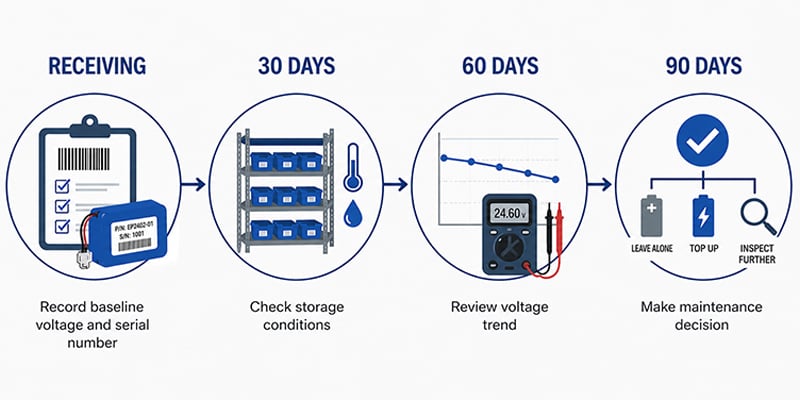
A 30-60-90-day maintenance cadence helps turn stored battery packs from passive inventory into controlled, traceable assets.

Why Stored Battery Packs Still Need Attention
Many battery issues found in the field do not start in the field. They start in storage, where the pack looked acceptable because no one measured it.
Three main things happen while a battery pack is stored:
- Calendar aging
- Self-discharge
- Background current draw from the Battery Management System (BMS)
Calendar aging happens over time and is affected by factors such as temperature and state of charge. Self-discharge slowly moves the pack toward the lower end of its storage range. The BMS may also draw a small amount of current while the pack is stored, depending on the pack design.
If the pack sits long enough, these factors can eventually pull the cells below the manufacturer's recommended cutoff voltage. Once that happens, the issue is no longer just a low state of charge. The cell chemistry can begin to change, and some of those changes may not be reversible.
This is why storage should not be treated as a passive condition. A short, scheduled check can turn storage from guesswork into a controlled process.
Start With a Receiving Baseline
The most important reading is the first one. Every later check depends on having a baseline to compare against.
At receiving, the pack should be inspected and logged before it is placed into storage. The basic information should include:
- Serial number
- Date received
- Measured pack voltage
- Ambient temperature
- Visual condition
- Name of the person taking the reading
This does not need to be complicated, but it does need to be consistent. Without a baseline, it is much harder to tell whether a later voltage reading is normal or abnormal.
For example, a battery pack that measures slightly below the middle of the storage window after 90 days may be acceptable if it started near that point. The same reading may be a warning sign if the pack started much higher and dropped faster than expected. Without the receiving data, both situations look the same.
The storage environment should also be documented. A pack stored within the conditions listed on its data sheet is more likely to age as expected. A pack stored outside those conditions can age faster, and the effect may not be obvious until the pack is needed.
The cost of skipping the baseline is that every later conversation about the pack comes down to memory instead of records.
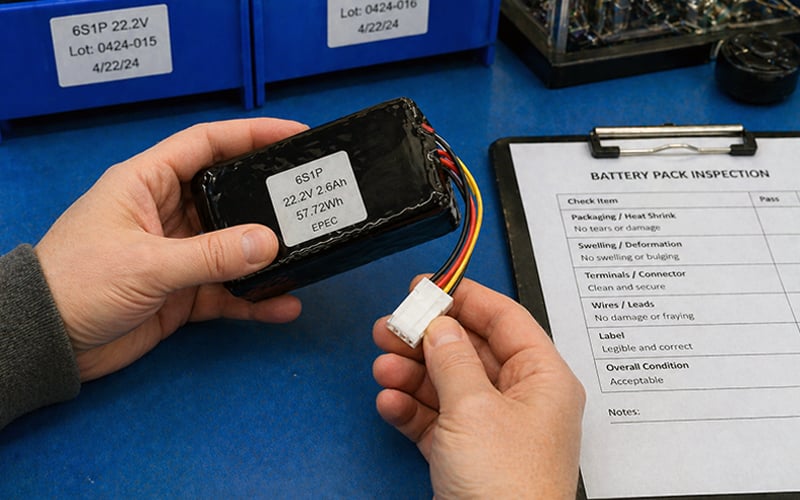
A receiving inspection should document the pack's serial number, voltage, physical condition, and storage status before the battery is placed into inventory.
The 30-Day Check: Confirm the Storage Conditions
At the 30-day point, the pack voltage should not have moved significantly if the pack is healthy and stored properly. The most important check at this stage is usually the storage environment.
Warehouses and stockrooms change over time. A pallet may get moved near a heat source. A storage rack may end up in direct sunlight. A roof leak or ventilation issue may increase humidity. Packaging may get damaged. Terminals may become exposed. None of these changes are complicated, but they can affect the pack if they go unnoticed.
The 30-day check should focus on the basics:
- Is the pack still in the correct storage location?
- Is the area cool, dry, and stable?
- Is the packaging still intact?
- Are the terminals protected?
- Is there any swelling, leakage, corrosion, damage, or other visible concern?
- Is the measured voltage still close to the receiving baseline?
This first checkpoint is mainly about catching problems before they turn into electrical issues. An environmental problem caught at 30 days is usually easier to correct than one discovered after several months of storage.
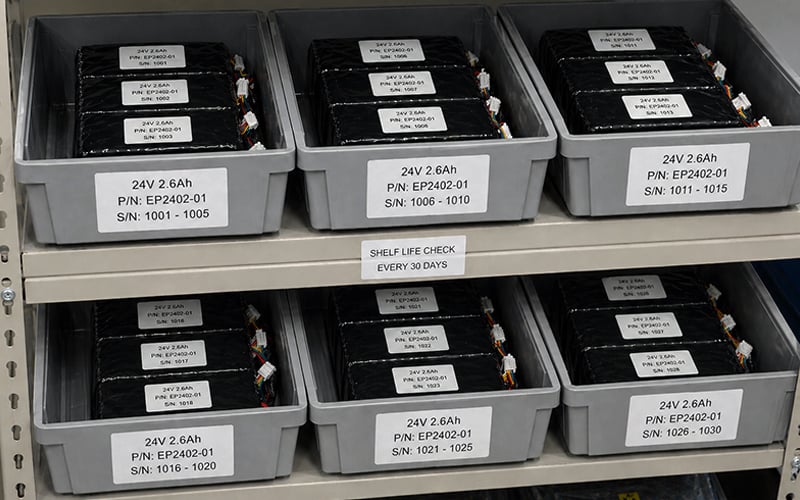
Stored battery packs should be clearly labeled, organized by part number and serial number, and checked on a routine schedule to confirm proper storage conditions.
The 60-Day Check: Look for Voltage Drift
By 60 days, the voltage trend is usually meaningful enough to compare against the expected self-discharge rate. Two voltage readings taken roughly two months apart, under similar temperature conditions, can show whether the pack is behaving normally.
A small voltage change may be expected, depending on the chemistry, pack design, and storage conditions. A drift rate that is within the expected range suggests that the pack is behaving normally and the storage environment is not creating an obvious issue.
A higher-than-expected drift rate should be investigated. The first thing to check is whether the environment has changed since the 30-day inspection. If the pack was moved to a warmer area, exposed to humidity, or stored incorrectly, the storage condition may be the cause.
If the environment has not changed and the pack is still losing voltage faster than expected, the issue may be inside the pack. That could point to an elevated leakage path, a weak cell group, a cell defect, a seal issue, or another internal condition that needs further review.
The value of the 60-day check is timing. A pack with abnormal self-discharge is much easier to deal with before it reaches a deeply discharged state. Waiting until the pack is needed for installation removes most of the useful options.
The 90-Day Check: Decide What to Do with the Pack
The 90-day checkpoint is where the storage data should turn into a decision. The pack should not automatically be charged just because 90 days have passed. The right action depends on the measured voltage, the trend, the storage conditions, and the requirements listed in the pack documentation.
There are usually three possible outcomes:
1. Leave the Pack Alone
If the pack is still within its recommended storage voltage range and the voltage trend looks normal; the best action may be to leave it alone.
Charging is not free from an aging standpoint. Unnecessary top-ups can add wear without adding meaningful value. For lithium-based packs, holding the cells at a full state of charge generally creates more chemical stress than storing them at a moderate state of charge.
A logbook full of 100 percent readings does not automatically mean the packs are being stored correctly. In some cases, it means the packs are being kept at a higher state of charge than needed.
2. Top Up to the Storage Range
If the pack has dropped below the recommended storage window, it should be charged using the approved charger or approved procedure.
The target should usually be the proper storage range, not full charge, unless the documentation specifically says otherwise. The goal is to restore enough headroom for continued storage without putting the pack into a high state of charge for no reason.
This is one of the most common mistakes in battery maintenance. A low stored pack does need attention, but that does not automatically mean it should be fully charged.
3. Pull the Pack Aside for Further Review
If the pack shows abnormal voltage drift, physical damage, swelling, leakage, corrosion, or any other sign of concern, it should not be treated as normal inventory.
A controlled evaluation may be needed. This could include a low-rate charge and discharge, a delivered capacity check, or a review against the original commissioning data or pack data sheet. The correct process depends on the pack design, chemistry, customer requirements, and safety considerations.
The important point is that an abnormal pack should be identified before it is installed into equipment. Storage maintenance is not just about keeping packs charged. It is also about finding the packs that should not be used without further review.
Avoiding the Two Common Storage Mistakes
The first mistake is doing nothing. If stored packs are never checked, self-discharge and BMS current draw can eventually pull them into a deeply discharged state. In some cases, the pack may shut down through the protection circuit. In the worst cases, the cells may be pulled below a safe recovery point.
The second mistake is charging too often or charging to full by default. This can reduce calendar life, especially for lithium-based packs stored for long periods. A pack does not need to be kept full to be maintained properly. It needs to be kept within the correct storage range.
A good 30-60-90 cadence avoids both problems. It prevents the pack from being forgotten, but it also avoids unnecessary charging.
Summary
Battery packs in storage should be managed with the same discipline as any other critical inventory. They may not be in service, but they are still aging, self-discharging, and responding to the environment around them.
A basic 30-60-90 day cadence gives customers a practical way to protect stored battery packs without overcomplicating the process. The receiving check creates the baseline. The 30-day check confirms the storage environment. The 60-day check starts to show the voltage trend. The 90-day check determines whether the pack should be left alone, topped up to the proper storage range, or pulled aside for further evaluation.
The result is a better record of each pack's storage life and a lower chance of discovering a problem only after the pack is needed in the field.
Key Takeaways
- Stored battery packs are not inactive. Self-discharge, calendar aging, and BMS current draw can affect the pack over time.
- A receiving baseline is critical. Without the first voltage reading, later readings are harder to interpret.
- The 30-day check should focus on storage conditions, packaging, terminal protection, and visible damage.
- The 60-day check helps identify abnormal voltage drift before the pack reaches a deeply discharged state.
- The 90-day check should lead to a decision: leave the pack alone, top it up to the correct storage range, or pull it aside for further review.