



There are few things more frustrating than finding out a connector, terminal, header, or small cable assembly component is no longer available. On the surface, it may seem like a simple sourcing issue. One part went obsolete, so you find another one and move on.
It is rarely that easy.
For many OEMs, an obsolete connector can create a chain reaction across engineering, purchasing, production, service, and field support. The part may be small, but it may be tied to a product design that has already been tested, approved, and shipped for years. It may need to mate with equipment already installed in the field. It may fit into fixed housing, line up with an existing printed circuit board (PCB) or connect to a cable assembly that cannot be changed without affecting the rest of the product.
The challenge becomes even greater when the obsolete component interfaces directly with a printed circuit board assembly (PCBA). Many connectors, headers, board-to-board interfaces, and wire-to-board systems are designed around specific PCB footprints, mounting methods, pin spacing, and mechanical clearances. A replacement that appears equivalent on paper may require PCB layout changes, enclosure modifications, or requalification of the entire assembly.

That is when a discontinued component becomes more than an inconvenience. It has become a real business problem.
Why Obsolete Connectors Cause Bigger Problems Than Expected
Connectors and cable assembly components are often designed around specific mechanical and electrical requirements. Pin spacing, housing geometry, latch features, terminal shape, contact material, mounting style, and overall fit all matter. Even a component that looks similar in a catalog may not work once it is placed into the actual assembly.
This is particularly true for components mounted directly to PCBAs. Surface-mount headers, through-hole connectors, board-to-board interconnects, card-edge connectors, and specialty terminals are often integrated into the original PCB layout. Any change to those components can create ripple effects throughout the assembly, potentially impacting signal integrity, mechanical fit, assembly processes, and long-term reliability.
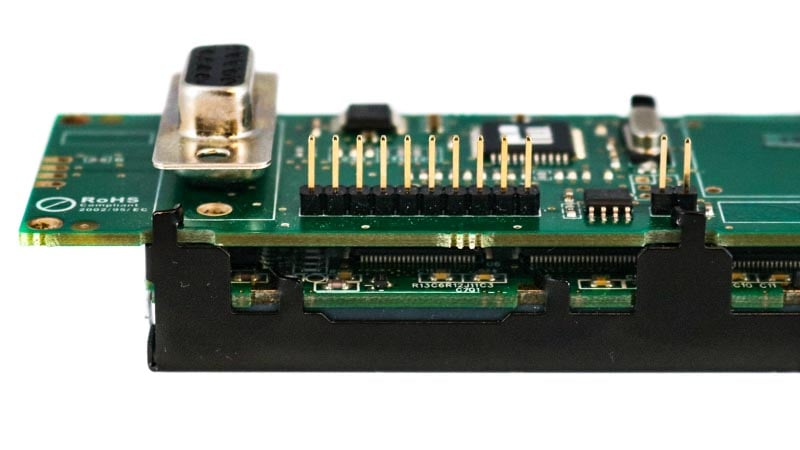
PCBA with header and numerous board mounted components.
A small change can affect how the part mates, how it fits into the enclosure, how the cable exits the assembly, or how the product performs over time. In some applications, changing the connector may also require updates to drawings, test procedures, tooling, labels, manuals, inventory, and replacement parts.
For products with long lifecycles, this can be especially difficult. Medical devices, industrial equipment, defense systems, transportation products, and other long-life applications often need support well beyond the availability window of certain commercial components. A product may still be performing well in the field, but one unavailable connector can put future builds or service programs at risk.
When Redesigning the Product Is Not Practical
In a perfect world, every obsolete component could be replaced with a readily available modern equivalent. But most engineering and sourcing teams know from experience that this is rarely the case.
Sometimes the product design is already locked. Sometimes there are too many units in the field to change the mating connector. Sometimes the cost of redesign, validation, and documentation is far greater than the cost of recreating the original part. In other cases, the customer may need a drop-in replacement because backward compatibility is critical.
There is also the timing issue. Redesigning around a new connector can take weeks or months, especially if the change affects multiple assemblies or requires additional testing. If production is already waiting on parts, that delay can be painful.
This is where reverse engineering can provide a practical path forward.
How Reverse Engineering Can Help
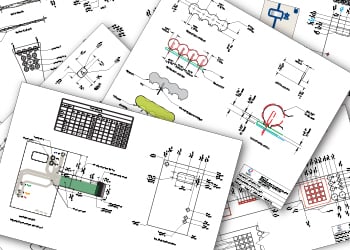
Reverse engineering gives companies a way to recreate an obsolete or hard-to-source component when an off-the-shelf replacement is not available or not acceptable. Instead of forcing a product redesign, the existing part can be reviewed, measured, modeled, and evaluated so a replacement can be developed.
This process may start with an existing sample, drawing, mating component, or available design information. From there, our team can look at the part’s fit, form, and function. What does it need to connect to? How does it mount? What materials are required? Are there any surface finish requirements? What mechanical features are critical? What production quantities are needed? And yet there still may be unanswered questions.
For cable assembly applications, this may include components such as connectors, headers, pins, terminals, plastic housings, metal contacts, and custom interface parts. The goal is to recreate the component closely enough to support the existing design while also making sure it can be manufactured consistently.
From One Sample to a Production Solution
One of the most helpful parts of this approach is that it does not have to stop at a drawing. Once the component has been reviewed and the requirements are understood, tooling can be developed to support production. Samples can then be built and checked for fit, performance, and manufacturability.
That sample stage is important. It gives the customer a chance to confirm that the replacement part works within the actual assembly before moving into larger production quantities. It also helps identify any adjustments that may be needed before committing to full production.
For companies facing supply chain risk, this can bring some much-needed control back into the process. Instead of relying on limited leftover inventory, inconsistent broker sources, or parts with uncertain history, the customer can move toward a more stable, repeatable supply path. Lifetime buys can be reconsidered, allowing production to proceed.
Material Selection Matters
Recreating the shape of a component is only part of the job. Material selection also plays a major role in performance and reliability.
Depending on the application, plastic materials may include nylon/PA66, glass-filled resins, ABS/PC blends, or other materials selected for strength, electrical insulation, heat resistance, or dimensional stability. Metal components may use brass, copper, or other conductive materials depending on the electrical and mechanical requirements.
This is one area where it helps to look beyond the part itself and consider the full operating environment. Will the component see heat, vibration, moisture, repeated mating cycles, or mechanical stress? Does it need to maintain tight dimensional tolerances? Does it need to match an existing mating interface exactly?
Those details can make the difference between a part that simply looks right and one that performs reliably in the field.
Reducing Long-Term Supply Chain Risk
Obsolescence is not always a one-time issue. For many companies, it is part of a larger supply chain challenge. Components get discontinued. Suppliers change priorities. Tooling is lost. Lead times stretch. Broker inventory becomes expensive or unreliable.
Reverse engineering and custom production can help reduce that risk by creating a more controlled path for replacement parts. It can also help companies continue supporting legacy products, aftermarket programs, and long-life equipment without immediately forcing a larger redesign.
That does not mean reverse engineering is the answer for every obsolete component. Sometimes redesigning around a newer part is the better long-term choice. But when the existing design cannot easily change, or when field compatibility is critical, recreating the component may be the most practical solution.
Summary
An obsolete connector may be a small part, but it can create a large problem. For companies to try to keep production running, support fielded equipment, or avoid an expensive redesign, reverse engineering can offer a realistic way forward.
If you are dealing with a discontinued connector, terminal, header, pin, or related cable assembly component, Epec can help evaluate the part, review the application, develop tooling, build samples, and support production quantities.
Sometimes the best solution is not starting over. Sometimes it is finding a smart way to keep a proven product moving.
Key Takeaways
- An obsolete connector can impact far more than a single part, often affecting cable assemblies, PCBAs, enclosures, documentation, testing, inventory, and field service programs.
- Components that interface directly with PCBAs are especially difficult to replace because changes may require PCB layout modifications, requalification testing, and updates to mating hardware already deployed in the field.
- Reverse engineering can provide a practical alternative to a costly redesign by recreating obsolete connectors, headers, terminals, housings, board-level interconnects, and other critical electromechanical components.
- Successful replacement components require more than matching physical dimensions. Material selection, plating finishes, solderability, mechanical performance, and compatibility with existing assemblies must also be considered.
- When backward compatibility is critical, reverse engineering and custom manufacturing can help extend product lifecycles, reduce supply chain risk, and keep production moving without forcing unnecessary design changes.