




Flexible circuits use either polyimide coverlay or flexible LPI solder mask to encapsulate external circuitry, each with distinct performance and design requirements. Polyimide coverlay is the most widely used due to its durability, flexibility, and dielectric properties, while LPI solder mask is applied similarly to rigid circuits but behaves differently in flex applications.
Material selection and design approach directly affect bend performance, feature definition, and long-term reliability.

Coverlay vs. Flex LPI
Two primary materials are used to encapsulate the outer layers of a flex circuit: polyimide coverlay and flexible liquid photoimageable (LPI) solder mask. While both protect the circuitry, they differ significantly in construction method, flexibility, and application requirements.
Polyimide coverlay is the most commonly used solution across the industry, offering a robust and flexible protective layer with strong dielectric performance. Flexible LPI solder mask, while similar in formulation to rigid circuit board solder mask with added flex agents, is applied as a liquid and processed similarly to rigid circuit manufacturing.
Coverlay Materials & Construction
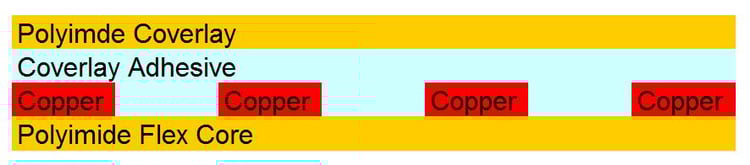
Polyimide coverlay is a sheet-based material made of two layers:
- A polyimide film
- An epoxy or acrylic-based adhesive layer
The adhesive serves two purposes: bonding the film to the flex circuitry and encapsulating the conductive features. During fabrication, the coverlay is aligned and laminated onto the circuit surface using heat and pressure.
Typical Coverlay Stack Configurations
Coverlay is available in multiple film and adhesive thickness combinations. The most commonly used configuration is 1 mil polyimide film + 1 mil adhesive.
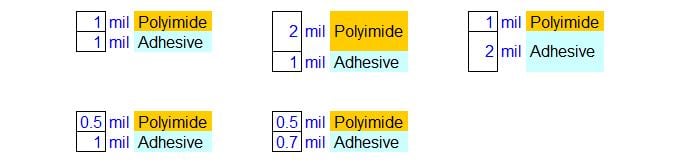
Material selection depends on several key design factors:
- Bend requirements, where thinner constructions may be needed for tighter bend radius
- Copper weight, requiring sufficient adhesive thickness for full encapsulation
- Cost considerations
- Dielectric withstanding requirements in certain designs
A general guideline is that a minimum of 1 mil of adhesive is required per ounce of copper to ensure proper encapsulation.
SMT & PTH Feature Openings in Coverlay
Unlike LPI solder mask, which is patterned photolithographically, coverlay openings for SMT and plated through-hole (PTH) features must be mechanically created.
Common methods include:
- Drilling
- Routing
- Laser cutting
- Knife cutting
- Punch and die
The chosen method depends on feature geometry, complexity, and production volume.
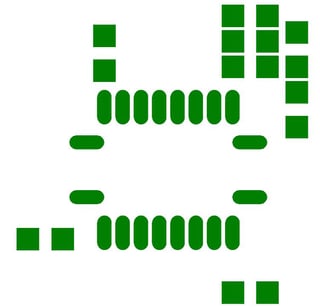

Data as Supplied Revised Gang Opening Configuration
Design Implications for Coverlay Openings
Mechanical processing creates additional design constraints compared to LPI:
- Larger minimum annular rings are required to account for tolerance and adhesive flow during lamination
- Wider web spacing between adjacent openings is necessary to prevent fragile sections and ensure adequate adhesive coverage
- Isolated “island” features are not feasible, as they will detach during machining
To address high-density designs, multiple openings are often combined into larger “ganged” features to maintain manufacturability and reliability.
Coverlay and Flex LPI Design Combinations
Some flex circuit designs require the use of both polyimide coverlay and flexible LPI solder mask within the same construction. Each material is applied selectively to different regions based on performance needs.
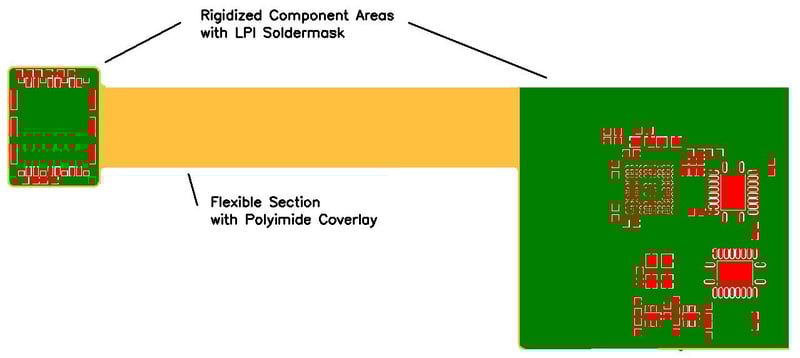
Common Hybrid Configurations:
- LPI solder mask applied in rigidized component areas
- Polyimide coverlay applied in flexible regions
- Selective solder mask webs used within ganged coverlay openings
Manufacturing data is structured so that these materials overlap within rigidized sections. This ensures complete encapsulation of circuitry while avoiding stress concentration points in flexible regions.
This approach increases design complexity and cost but can be necessary to balance durability, flexibility, and assembly requirements.
Additional Design Considerations
Certain features and materials require careful evaluation when selecting between coverlay and LPI solder mask. In some cases, coverlay must be used because LPI may not provide sufficient adhesion or meet quality requirements.
Applications that often require coverlay in specific areas include:
- ZIF finger regions
- Polyimide stiffeners
- FR4 rigidizing stiffeners
- Silver ink shield layers
- EMI and RF shielding films
- Pressure-sensitive adhesives (PSA)
These materials may not adhere reliably to LPI solder mask, making polyimide coverlay the preferred solution.

Summary
Polyimide coverlay and flexible LPI solder mask each serve as protective layers in flex circuit designs, but their performance and design implications differ significantly. Coverlay provides a durable, flexible, and widely accepted industry solution, while LPI offers processing advantages in certain rigidized areas. Design complexity, feature density, and application requirements determine whether a single material or a hybrid approach is required.
Key Takeaways
- Polyimide coverlay is the industry standard for flex circuit encapsulation due to durability, flexibility, and dielectric performance.
- Coverlay construction consists of a polyimide film and adhesive layer, typically in a 1 mil / 1 mil configuration.
- Mechanical machining of coverlay openings requires larger features, wider spacing, and elimination of isolated structures.
- Flexible LPI solder mask is applied similarly to rigid circuits but has different performance limitations in flex applications.
- Hybrid designs combining coverlay and LPI improve reliability in complex or high-density flex circuits.
- Certain materials and features require coverlay due to adhesion limitations of LPI.