




Medical devices using portable battery packs require special design considerations to ensure optimal power for these devices while upholding the highest levels of safety. The medical devices can use lithium-ion, lithium metal, lead acid, NiMH, silver-oxide, and alkaline battery cells based on power requirements and usage. The battery packs cannot malfunction when in use, during sterilization, or when placed into storage.
Critical safety requirements focus on minimizing issues such as faults, short circuits, overcharging, over-discharging, thermal runaway, and other factors that can happen to the battery cells.

Critical Safety Requirements
Fault Condition Safety
Medical devices may experience fault conditions that impact voltage and current rates. Typically, an electrical system will operate at a nominal current and voltage. This nominal current and voltage are determined using a formula based on Ohm's Law (I = V / R or V = IR): where the current (I) is directly proportional to the voltage (V) within the electrical circuit of the device, as well as being inversely proportional to the present resistance (R).
A fault condition occurs when there is a drastic increase in current and a formidable drop in voltage. With the low resistance along the fault path, the voltage can drop to near zero or zero while the current is extremely high. This problem leads to a short circuit, ground fault, or other type of fault condition. These fault conditions may cause medical device failure, damage, reverse polarity, overloading, or even a fire.
To deal with fault conditions, safety protections such as insulating the cell terminals can help create a protective non-conductive barrier to stop the terminals from accidentally touching. Grid enclosures can also keep cells separate while also offering a cushion from mechanical shocks, vibrations, or drops.
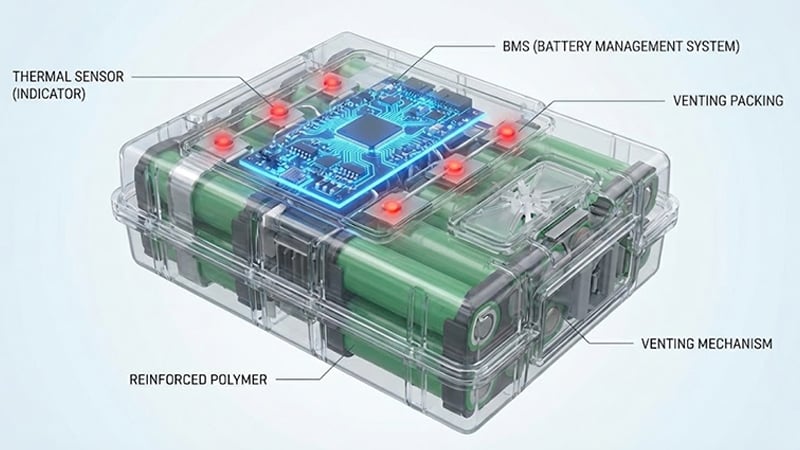
Advanced medical battery pack design featuring integrated BMS, thermal sensing, and venting systems to ensure safe, reliable power across all operating conditions (Image created by AI).
External or Internal Use Restrictions
Medical devices will have varying operating environments when used with patients. These tools are used to perform examinations, for treatments, to record patient information, during surgeries, or inserted internally for specified periods of time. Due to these factors, designs for medical battery packs must take into consideration factors such as leakage, thermal runaway, and flammability that could harm the patient.
Leakage may occur in the battery’s electrolyte. This electrolyte is a hazardous material that should not be encountered or consumed by a patient. Leakage may also consist of bodily fluids that may come from the patient and cover the medical device.
Thermal runaway is a dangerous event where the instability of a battery cell causes it to overheat. This overheating moves from one cell to the next, leading to significant battery damage as well as a possible fire or explosion.
Flammability may occur due to battery pack damage such as punctures, thermal runaway, short circuits, cell swelling, loose connections, high operating temperatures, and mishandling or misuse.
Identifying these potential risks during design and testing allows manufacturers to place safeguards to minimize the danger of electrolyte leakage, thermal runaway, and flammability. A specially-designed battery enclosure protects from outside leakage and prevents interior electrolyte leakage from escaping to harm the patient. Fans and vents may be installed to provide cooling to control fluctuating temperatures. Connecting a battery management system (BMS) to the battery cells also allows for enhanced monitoring and safety.
A BMS constantly monitors a battery pack’s temperature, voltage, current, state of health (SoH), and state of charge (SoC). It gathers data about the current conditions of the cells and compares them to set safety parameters. If the battery’s condition goes outside these parameters, the BMS will activate. These actions may involve sending an alert to the medical device user, turning off charging capabilities, or switching into safe mode.
In addition to testing medical battery packs for defects and design flaws, manufacturers also provide documentation and guidelines to warn about the above dangers of thermal runaway, leakage, and flammability. These warnings provide details regarding medical battery pack usage, such as the environment in which the packs should be used and certain operational factors to avoid.
Medical Battery Pack Standards
The Federal Drug Administration (FDA), the International Organization of Standardization (ISO), and the International Electrochemical Commission (IEC) have standards that focus on the performance and safety of battery packs that are designed using certain chemistries, such as lithium-ion. These standards dictate how manufacturers document, validate, and test medical devices and medical battery packs.
ISO 13485 Standard
The ISO 13485 is an international compliance standard for medical device manufacturers. These standards provide guidelines on how to design and construct medical devices to meet safety and performance requirements. These guidelines are divided into 4 classes based on risk.
IEC 60601-1
IEC 60601-1 standard focuses on basic safety, performance, and risk management requirements for medical electrical equipment. Manufacturers may use the standard to gain regulatory approval for market access in different regions.
UN38.3
The UN38.3 covers all testing standards for lithium-based batteries for transportation safety. The testing criteria evaluate the risks and hazards that batteries may undergo when shipped separately and with medical devices.
UL 2054
UL 2054 offers safety certifications for primary and secondary batteries. This standard gives guidelines on both household and commercial batteries used as a single cell or in multi-cell operations.
Summary
There are unique challenges and stringent requirements associated with designing battery packs for medical devices, particularly when those devices are used on or near patients. Careful attention to fault protection, leakage prevention, thermal management, and flammability is essential to ensure safe operation throughout use, sterilization, transport, and storage.
By incorporating protective mechanical designs, robust battery management systems, and validated safety controls early in development, manufacturers can significantly reduce risk while improving long-term reliability. Adhering to established standards such as ISO 13485, IEC 60601-1, UN38.3, and UL 2054 not only supports regulatory compliance but also helps build trust in the safety and performance of medical battery-powered products.
Key Takeaways
- Safety drives every medical battery design decision: Medical battery packs must operate reliably during use, sterilization, storage, and transport, with zero tolerance for failures that could impact patient safety.
- Fault condition protection is essential: Short circuits, overcurrent events, and voltage drops must be addressed through insulation, physical separation of cells, robust enclosures, and electrical safeguards to prevent damage, fire, or device failure.
- Risk mitigation depends on enclosure and monitoring design: Properly engineered enclosures, along with cooling features such as vents or fans, help reduce the risk of leakage, thermal runaway, and flammability in both external and implantable medical devices.
- Battery management systems are a core safety requirement: A BMS continuously monitors temperature, voltage, current, state of charge, and state of health, and can trigger alerts, shut down charging, or place the device in a safe state when limits are exceeded.
- Regulatory compliance validates long-term safety: Standards such as ISO 13485, IEC 60601-1, UN38.3, and UL 2054 define the testing, documentation, and validation needed to confirm that medical battery packs meet strict safety and performance expectations.