




Controlling thermal management requires the use of external and internal devices to ensure that the battery operates at the optimal level in the specific environment when there are fluctuating temperatures.
When discussing thermal management, we often focus on elevated temperatures, as this excess heat may cause damage, advanced aging, or thermal runaway. However, cold temperatures are also a threat to a battery pack's state of health (SoH) and state of charge (SoC). Installing flex heaters in battery packs allows the batteries to operate fully in cold conditions.

How Cold Temperatures Affect Batteries
When batteries operate in cold temperatures, the chemical reaction that is required to make electricity is slowed down. Due to this aspect, the battery must work twice as hard to produce its standard level of power, which results in less electrical output. Also, as the electrolyte freezes, this factor increases the internal resistance of the battery. The device often runs slower in colder temperatures since it is not receiving enough battery power.
Another disadvantage is that batteries lose their capacity in cold environments. This problem greatly impacts lithium-based batteries that should not operate in temperatures below 32°F. When batteries reach these extremely low temperatures, lithium ions detach to plate the surface of the anode. This problem reduces the capacity of the battery. Charging the battery at this temperature should also be avoided as the charging phase can also lead to battery damage.
Using Flex Heaters to Maintain Ideal Battery Temperatures
Using devices in cold temperatures sometimes cannot be avoided. They may be seasonal or environmental. Environmental circumstances may involve applications such as refrigerated warehouses, chemical factories, food processing plants, medical and pharmaceutical workplaces, or aerospace industries. To maintain the right temperature, a flex heater will be installed on the battery pack.
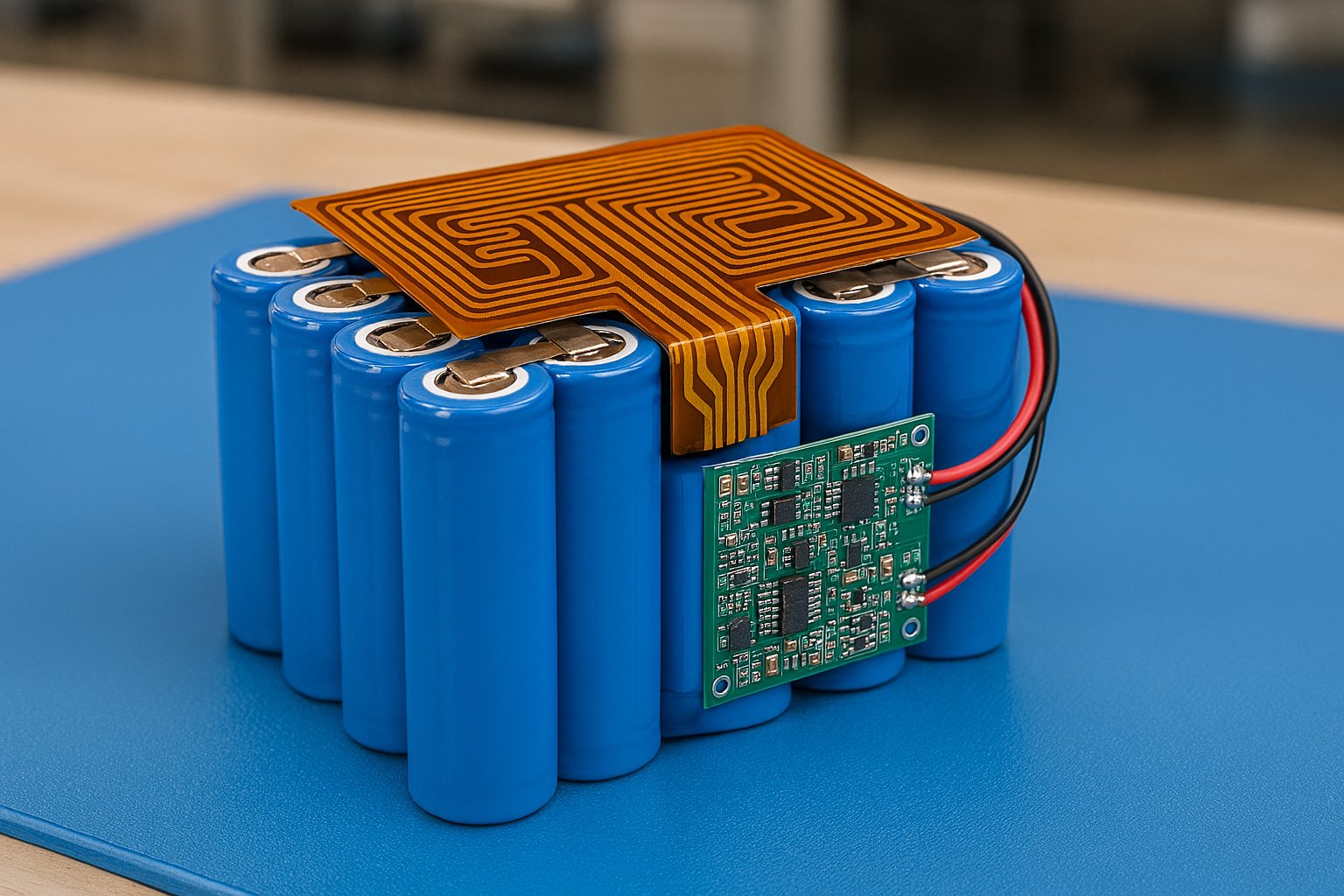
AI-generated image of a battery pack with a polyimide flexible heater to help maintain temperature.
As the name suggests, a flexible (flex) heater can bend and flex without any disruption to its heating elements. It is made with either wire-wound heating elements or etched foil circuit elements that are sandwiched between a lightweight outer material that allows for optimal heat transfer to the device. Heat passes from the flex heater and through the surface of the battery pack enclosure to provide warmth to the battery cells.
How Flex Heaters Work with Batteries
Flex heaters are self-regulated. They work independently to provide optimal heating to the battery pack. So there typically will not be any worker intervention or oversight for the heater while the device is in operation. Instead, the heater will be designed to provide the right temperature based on the customer's set requirements and manufacturer parameters for the application and the battery's heating needs. Lithium-based batteries and hydrogen fuel cell batteries are the two cell chemistries that benefit from the use of flex heaters.
The main components of a flex heater consist of the heating elements, protective surface materials, sensors, and controls. Thermocouples, thermistors, thermal fuses, RTDs, and thermostats are also incorporated directly into the heater and can have preset or adjustable settings. This design allows the heater to be mounted with the battery pack without significantly adding additional weight or taking up additional space. Customers have a variety of choices for materials, such as silicon rubber, Kapton/Polyimide, and polyester.
- Silicon rubber offers chemical resistance and water resistance. This material works with wire-wound elements or etched foil circuits. Silicon rubber is a thicker material as it offers more stability and strength when the battery is used in rugged environments.
- Kapton/Polyimide consists of a polymer film with an etched foil element. While the polymer film is lightweight, it offers a large amount of flexibility.
- Polyester flex heaters are a type of screen-printed heaters using ink. These heaters are water-resistant and don't require a lot of power to operate.
Mounting the flex heater can vary depending on the application, available space, and size of the battery. The heater can be vulcanized to the surface of the enclosure, attached using adhesive, or mounted using clips.
Considerations When Selecting Flex Heaters
When considering the use of flex heaters, take into account the materials and size/shape of the heater. Some battery packs need to be flexible in the application, such as a rounded tool. Kapton/Polyimide and polyester flex heaters offer more flexibility and can be shaped around corners and rounded enclosures. On the other hand, larger applications may need a heater that provides uniform heat over a large space. In this instance, silicon rubber offers an ideal solution.
Another consideration is the temperature. If the environment requires higher temperatures, you want to select a heating element that provides good wattage. Etched foil elements can provide higher watt density than wire-wound applications. Also consider the materials of the device and how it will react to the increase in temperatures coming from the battery pack. You want to ensure that the materials are compatible with each other while working against the flex heater.
Summary
Batteries installed with flex heaters allow applications to run in colder environments without losing power or capacity. With the variety of flex heaters available, customers can select the appropriate elements and heater materials that will work with the device.
Key Takeaways
- Flex heaters enable battery operation in cold conditions: They prevent power loss and capacity reduction caused by slowed chemical reactions and increased internal resistance at low temperatures.
- Different heater materials suit different needs:
- Silicon rubber offers rugged durability and chemical resistance.
- Kapton/Polyimide provides lightweight flexibility for tight or curved spaces.
- Polyester offers low-cost, water-resistant heating for low-power needs.
- Self-regulating temperature control: Flex heaters operate autonomously, maintaining optimal warmth using built-in thermocouples, thermostats, or sensors without requiring user intervention.
- Versatile mounting options: Heaters can be attached with adhesives, clips, or vulcanized to the battery enclosure, depending on available space and design needs.
- Design factors affect performance: Selecting the right heater material, shape, and watt density ensures heat distribution and compatibility with battery materials, leading to longer life and reliable cold-weather performance.