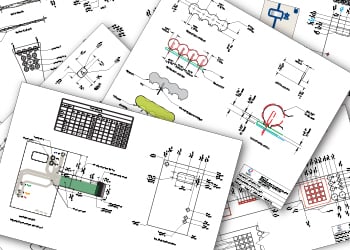




For decades, 130°C and 150°C Tg FR-4 materials were widely used throughout the printed circuit board industry. Many legacy PCB drawings still specify these materials today. However, PCB manufacturers are finding that traditional 130°C and 150°C Tg FR-4 laminates are becoming increasingly difficult to source.
The reason isn't that laminate manufacturers can no longer produce these materials. Instead, the PCB laminate market has evolved toward higher-performance FR-4 materials, particularly 170°C Tg and above.
As demand has shifted, laminate manufacturers have less incentive to continue producing and stocking older, lower-Tg material systems.
What Is Tg in a PCB Laminate?
Tg, or glass transition temperature, is the temperature range where the resin system in a PCB laminate begins transitioning from a rigid, glass-like state to a softer, more flexible state.

Tg is an important PCB material characteristic, but it should not be considered by itself.
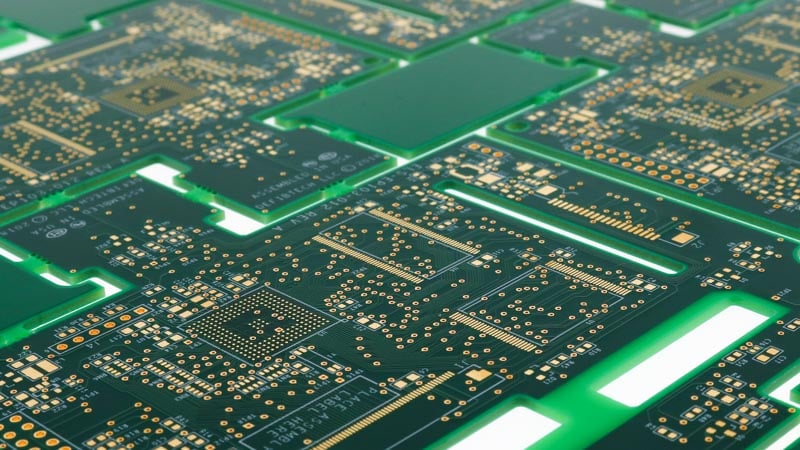
Printed circuit board manufactured with FR-4 laminate.
Other properties, including decomposition temperature (Td), Z-axis coefficient of thermal expansion (CTE), T260/T288 performance, moisture absorption, CAF resistance, dielectric properties, and overall thermal reliability can be equally important depending upon the PCB application.
This is one reason simply comparing two laminates based on Tg can be misleading.
Why Is the Industry Moving Away From 130°C and 150°C Tg FR-4?
Several factors are driving the change.
1. Demand Has Migrated Upward
The biggest reason 130°C and 150°C Tg FR-4 materials are becoming harder to find is simple: PCB industry demand has migrated toward higher-Tg materials.
Applications in aerospace and defense, automotive electronics, telecommunications, data centers, industrial controls, and other high-reliability markets increasingly require materials capable of handling greater thermal and mechanical stress.
At the same time, PCB designs have become more complex. Higher layer counts, greater circuit density, thicker constructions, more demanding via structures, and lead-free assembly have all increased the value of higher-performance laminate systems.
As a result, materials in the 170°C Tg and higher range have increasingly become mainstream FR-4 choices rather than specialty materials.
This creates a self-reinforcing cycle. As OEMs specify more high-Tg materials, PCB fabricators purchase more of them. As fabricators standardize their inventories around these materials, laminate manufacturers devote more production capacity to them. Distributors then stock the materials with the greatest demand.
Meanwhile, demand for traditional 130°C and 150°C Tg systems continues to decline.
Eventually, manufacturers reach a point where maintaining separate resin systems, production runs, certifications, prepreg constructions, and inventories for declining-volume materials no longer make economic sense.
The issue isn't that laminate manufacturers can't produce 130°C or 150°C Tg FR-4. There simply isn't enough demand to justify supporting as many of these material systems as there once was.
2. Lead-Free Assembly Increased Thermal Requirements
The transition to lead-free soldering increased PCB assembly temperatures. Higher processing temperatures and multiple reflow cycles place significantly greater thermal stress on PCB materials.
Higher-Tg FR-4 systems were developed to provide improved thermal performance and reliability under these conditions.
3. PCB Technology Has Become More Demanding
Today's printed circuit boards commonly incorporate higher layer counts, increased circuit density, smaller features, thicker constructions, and more complex via structures.
These changes have increased demand for higher-reliability laminate systems and reduced the number of applications where PCB manufacturers want to maintain a separate lower-Tg material platform.
4. Maintaining Lower-Volume Laminate Systems Is Expensive
A laminate family involves much more than a single sheet of material.
Manufacturers must support numerous combinations of core thicknesses, prepreg constructions, glass styles, copper weights, copper foil types, panel sizes, UL certifications, and IPC qualifications.
As demand for 130°C and 150°C materials declines, maintaining all these combinations becomes increasingly difficult to justify.
5. PCB Fabricators Are Consolidating Their Own Material Inventories
PCB manufacturers face the same inventory challenge.
Instead of stocking separate 130°C, 150°C, and 170°C Tg laminate systems, many circuit board fabricators prefer to standardize around a smaller number of higher-performance materials capable of supporting a broader range of applications.
This reduces inventory while providing greater flexibility when responding to customer requirements.
Lower Tg Doesn't Necessarily Mean Lower Cost
Historically, lower-Tg FR-4 was generally considered the economical choice.
That assumption is becoming less reliable.
When production volumes decline, a 130°C or 150°C Tg material can actually become more expensive and have longer lead times than a widely used 170°C Tg laminate.
The economics of laminate manufacturing are heavily influenced by production volume. A material manufactured frequently in large quantities can be more economical than an older technology that requires an infrequent specialty production run.
Therefore, specifying a lower Tg doesn't automatically result in a lower-cost PCB.
What Happens When a Legacy PCB Drawing Specifies 130°C or 150°C Tg?
This is becoming an increasingly important issue for legacy PCB programs. A drawing created 10, 15, or 20 years ago may specify a laminate system that was readily available when the PCB was originally designed but is now difficult to obtain.
The first step is determining exactly what the drawing requires.
For example, there can be an important difference between: "Tg = 130°C" and "Tg ≥ 130°C."
If the specification establishes a minimum Tg requirement, a modern higher-Tg FR-4 may potentially satisfy that requirement.
However, Tg alone should never be used to determine whether one laminate is an acceptable replacement for another.
Engineers should also evaluate characteristics such as IPC specification, UL recognition, decomposition temperature (Td), T260 and T288 performance, X-, Y-, and Z-axis CTE, dielectric constant (Dk), dissipation factor (Df), moisture absorption, CAF resistance, copper compatibility, finished PCB thickness requirements, and processing characteristics.
Customer approval may also be required before changing the laminate specified on an existing drawing.
Higher Tg Isn't Automatically a Drop-In Replacement
It can be tempting to assume that if 170°C Tg is "better" than 130°C Tg, the higher-Tg material can simply be substituted.
That isn't always the case.
Different resin systems have different mechanical, thermal, electrical, and processing characteristics. Changing the laminate can affect PCB fabrication as well as the performance of the finished circuit board.
This becomes especially important with controlled-impedance PCBs, high-speed digital circuits, RF applications, thick multilayer boards, and other designs where material properties directly influence performance.
The appropriate approach is to evaluate the complete laminate data set rather than focusing on Tg alone.
Planning for the Future of Legacy PCB Designs
OEMs maintaining legacy PCB designs should consider reviewing their laminate specifications before material availability becomes a production issue.
Where appropriate, manufacturers can work with their PCB supplier to identify currently available materials that meet or exceed the original design requirements.
Updating approved material lists or drawings before the original laminate becomes obsolete can prevent future supply disruptions, long lead times, minimum-order requirements, and unexpected material costs.
Compare PCB Laminate Materials
Epec works with a broad range of PCB laminate systems from the industry's leading material manufacturers. Our PCB laminate material comparison chart allows engineers and purchasing teams to compare commonly used laminate materials and their key properties, including Tg, Td, CTE, dielectric characteristics, and other important specifications. This can be used as a guide to compare available materials and identify potential alternatives for your PCB application.
When a material specified on an existing PCB drawing is obsolete, difficult to obtain, or experiencing extended lead times, Epec's engineering team can also help evaluate currently available laminate systems and determine potential alternatives based on the complete PCB design requirements.
The goal shouldn't simply be to find another material with the same Tg. The goal is to select the right material for the electrical, mechanical, thermal, reliability, and supply-chain requirements of the PCB.
Summary
The declining availability of 130°C and 150°C Tg FR-4 is less about these materials becoming technically obsolete and more about where the PCB industry is heading. As demand has shifted toward higher-performance laminates, manufacturers and PCB fabricators have increasingly standardized around 170°C Tg and higher material systems that can support a broader range of applications and processing requirements.
For legacy PCB designs, this makes it important to review laminate specifications before availability becomes a production problem. A higher-Tg material may be a suitable replacement, but Tg alone should never determine material equivalency. Thermal performance, CTE, electrical properties, moisture resistance, certifications, processing characteristics, and the requirements of the finished PCB all need to be considered.
Working with your PCB manufacturer to identify and qualify available materials currently can help avoid extended lead times, unnecessary costs, and future supply disruptions.
Key Takeaways
- 130°C and 150°C Tg FR-4 materials are becoming harder to source primarily because PCB industry demand has shifted toward 170°C Tg and higher-performance laminates.
- Lead-free assembly, higher layer counts, complex via structures, and more demanding applications have accelerated the industry's move toward higher-Tg material systems.
- Lower-Tg FR-4 does not necessarily mean a lower-cost PCB, as declining production volumes can result in longer lead times, minimum-order requirements, and higher material costs.
- A higher-Tg laminate should not automatically be considered a drop-in replacement for legacy material. Td, CTE, Dk, Df, moisture absorption, CAF resistance, certifications, and processing characteristics should also be evaluated.
- OEMs with legacy PCB designs should review older laminate specifications proactively and work with their PCB manufacturer to qualify for currently available alternatives before material availability impacts production.