


It’s no secret that as printed circuit boards (PCBs) have evolved into higher technology levels, it has become more difficult to process the boards in a standard production setting. By standard, I mean panelized boards popped onto the line or conveyor and letting them run. Copper is the driving processing factor for a lot of production; the ounce weight drives the part and determines how long.
As we process the boards carefully to get them to the final step, picking the right finish is critical. So, let’s talk about the flavors of surface finish.
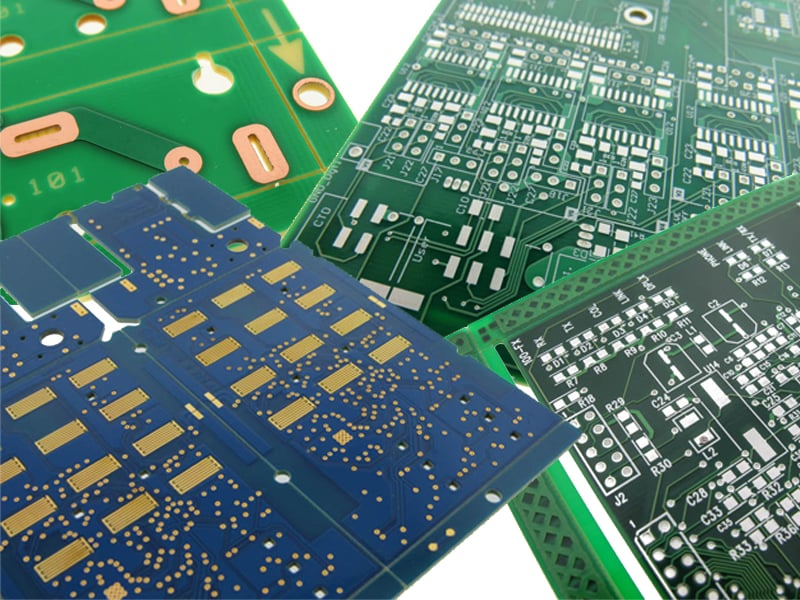
Printed circuit boards with various surface finishes.
History of HASL
Back in the day, the option for surface finish was tin/lead (Sn-Pb); the 60/40 or 63/37 are the typical callout numbers. This finish was a tinned leaded reflow process, where the tin was the metallic for assembly with the lead controlling the whiskers.

Since the early 1970s HASL, hot air solder level, has replaced tin-lead reflow process; it’s still the same makeup of tin and lead, however, the application has improved. Both the original and the improved application fell short in flatness, causing issues with assembly. Although the HASL application is still available, it is not used as much as the rest of the finishes available. I can’t ever see HASL going away entirely, mostly due to military, automotive, and other legacy work that would need to be pushed through red tape to make a major change, such as a surface finish change.
The Options After HASL
Prior to the 1990s, we knew lead was bad for us, our children, the environment, and our future, so the push for lead-free free was elevated to electronics. Paint is the one item that I remember the most containing lead, and I hear it has a sweet taste to it. Anyhow, the lead-free HASL processes were soon to follow. Now we already had a hard gold process for connectors and some selective keypad areas, so it shouldn’t be a surprise that gold, or in this case, ENIG electroless nickel immersion gold, was developed in the late 1980s as an alternative as designs pushed HASL out.
ENIG was noted for its exceptionally flat finish, particularly in fine pitch, tight spaces, and BGA areas. It had a long shelf life like HASL and was excellent at resisting corrosion. So, what is the negatives? Costs and availability. There were even some theft concerns, as we all know the cost of gold. Let’s review the different options, timeline development, issues, and what is the most commonly used finish.
Hot Air Solder Leveling (replaces tin-lead reflow) (Shelf Life 12 Months or More; Same with LF-HASL)
- Developed: 1970s
- Details: A tin-lead solder coating applied to pads and leveled with hot air knives. It became the industry standard for decades due to its low cost and good solderability
- Issue: Solderable surface flatness, shorting potential
- Shift away: Around 2000–2006, due to the EU RoHS Directive (lead-free requirements). Lead-free HASL versions (SnCu, SnAgCu) were introduced
Electroless Nickel Immersion Gold (ENIG) (Shelf Life 12 Months Typical, Most Widely Used)
- Developed: 1980s (patented around early 1980s by OMI International)
- Adoption: Widespread by the 1990s–2000s, especially for fine-pitch components and BGA packages
- Reason: Provides flat pads, excellent shelf life, and reliable bonding
- Issue: Initially black pad and it costs 15-20% higher than HASL
Immersion Tin (ImSn) (Shelf Life 6 Months)
- Developed: 1990s
- Adoption: Picked up after 2000 as a lead-free alternative to HASL
- Notes: Good coplanarity
- Issue: Tin whiskers and limited shelf life
Immersion Silver (ImAg) (Shelf Life 6 Months; Controlled Environment Recommended)
- Developed: Late 1990s
- Adoption: Became popular in the early 2000s with the lead-free push
- Notes: Flat, lead-free finish with good solderability
- Issue: Sensitive to handling and tarnish
Electrolytic Hard Gold (Shelf Life 12 Months or More)
- Developed: Much earlier. Used since at least the 1960s–70s for edge connectors
- Notes: Still used for high-wear contacts, keypads, tabs
- Issue: Cost
Organic Solderability Preservatives (OSP) (Shelf Life 3 to 6 Months)
- Developed: Late 1970s in Japan, early versions used rosin coatings
- Modern versions: 1990s onward, using azole-based chemistries
- Adoption: Became mainstream in the 2000s for lead-free assembly due to low cost and flat pads
- Issue: Short shelf life
Electroless Nickel Palladium Immersion Gold (ENEPIG) (Shelf Life 12 Months or More)
- Developed: Mid-1990s. Excellent for wire bonding, strong joint, reliable in harsh environments
- Issue: High cost due to processing being in a separate line, requests are LOW, cost is high for palladium
How To Choose A Surface Finish
With all the choices available, you may still wonder what type of finish you should request. Here are a few guidelines to help you select which one is best.
- Lead-free components require a higher temperature to apply, so pick a lead-free finish
- Fine pitch, tight space: Also go lead-free
- Small prototype for testing: HASL is lower cost; however, again, tight space, fine pitch, lead-free
- LF-HASL: Many facilities may not have this surface finish. Ask the question. Tt could actually cost more if they have to outsource the finish
- Avoid OSP if you are bringing in high volume that you are not going to assemble within 3 months or receipt
- Immersion tin can be problematic with whiskering and is our lowest requested finish
- Immersion silver: Like your grandma’s fine silver, these will tarnish and really can’t be cleaned and polished, a handling nightmare, so wear your cotton gloves. I always discourage silver
- Immersion gold is always the best option, and the cost is really not that much higher for the quality and problem-free finish
Summary
When it comes to cost and savings, it is true that HASL is still a lower cost, still available, Enig is the most requested and more expensive is extremely flat, easier to process, and not that much more expensive than the others. However, there are a lot of other factors to consider besides cost, for example, technology, pad to pad, pad to copper, and pad to circuit spacing.
For tighter technology, your choice should be ENIG or another lead-free finish. The finish is the final touch, considering the technology, the volume, when they will be assembled, and what the component choice details are, and lead-free processing.
Key Takeaways
- Surface finish selection directly impacts PCB performance: Choosing the right finish affects solderability, flatness, shelf life, and corrosion resistance, all of which influence long-term reliability.
- ENIG is the industry’s preferred finish: Electroless Nickel Immersion Gold offers a flat, durable, and corrosion-resistant surface ideal for fine-pitch and high-density applications, despite slightly higher costs.
- HASL remains cost-effective but limited: While Hot Air Solder Leveling (lead and lead-free) is affordable and widely available, its uneven surface makes it less suitable for modern, high-density designs.
- Each finish has trade-offs: Immersion silver and tin are affordable but prone to oxidation and whiskering, OSP has a short shelf life, and ENEPIG provides exceptional reliability at a higher price point.
- Application dictates finish choice: High-reliability, fine-pitch, or lead-free assemblies benefit from ENIG or ENEPIG, while prototypes or low-cost builds may still justify HASL for budget efficiency.