




Products that use battery packs may require certification through national and international quality and safety organizations. These regulations ensure that the battery packs meet compliance standards for packaging, transportation, use, storage, and disposal.
While some certifications are mandatory, others may be a requirement based on the industry and market. Other times, product manufacturers may seek out certifications for their products for public relations purposes to build customer trust and company branding.
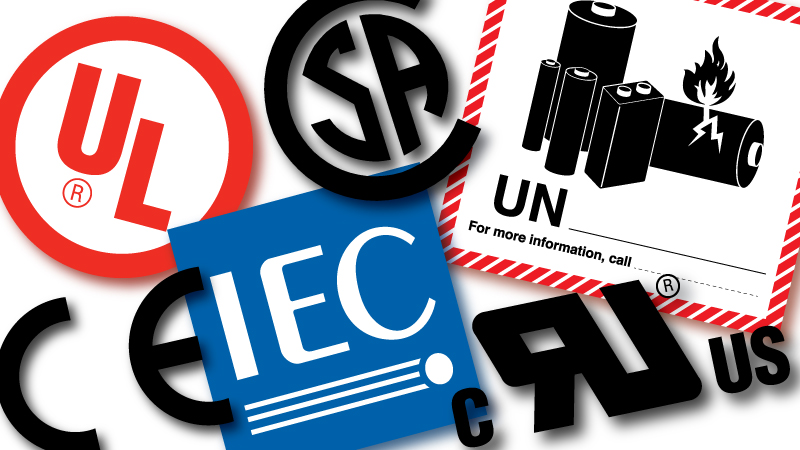
Various battery pack certifications.
Depending on the type of custom battery pack, you may have to select a certain material, cell chemistry, component, and enclosure design to reach compliance standards. Understanding the specifics of each certification standard before development can cut down on your time to market and keep costs manageable.

International and Country Certifications
Most countries and regions have developed application-specific compliance standards for custom battery packs, such as the UL for the United States and the European Union's EC certifications. They may also adopt international certification standards for health, safety, transportation, and environmental factors. Knowing where your product will be shipped and used allows you to tailor the design and development of the battery pack to these standards.
For example, all lithium batteries, whether shipped separately from the device, inside the packaging with the device, or pre-installed, require transportation certification in most countries. Depending on how it is shipped, such as by air, sea, train, or truck, will dictate which certification it will need, in addition to country-specific regulations, since lithium is categorized as a dangerous good. So, if you are shipping to Australia, you will need to obtain ADR transportation certification, while the United States has DOT standards, Canada has CSA certification, and India has mandatory BIS certification.
To streamline the process as much as possible, most countries will accept international certifications, such as UN38.3, IATA, IEC, and RoHS certifications for batteries. The CB Scheme is accepted in over 50 countries, as the battery pack will only need a single test certificate.
Application-Specific Certification
End-use devices with battery packs may require mandatory specifications for health and safety, as well as to ensure that the device can operate under certain environmental and operational conditions. All medical devices must undergo FDA testing, while devices that will be used in the defense industry have MIL-STD and MIL-PRF specifications. There may also be standards in other markets such as industrial, consumer electronics, chemical, food and beverage, and aerospace.
Researching requirements during the design phase ensures that the development and manufacturing of the battery pack run smoothly. It can prevent overlooking a standard where the battery pack must be changed after being developed, which can impact build times, increase costs, and produce material waste. It also allows our engineers at Epec to possibly offer cost-effective alternatives to the construction and materials used for the battery pack that will still comply with industry standards.
Component Standards
Certification organizations may require testing of the battery pack during certain build stages or for specific components. Components that are tested include the battery cell, production circuit board, and the battery management system (BMS) designed for lithium batteries.
Some components, such as the cells, will be tested throughout the manufacturing process to check capacity, state of health, charging/discharging rates, mechanical stresses, and other aspects. Other components will only be tested after completion, such as the circuit board.
The custom battery pack will also undergo performance battery cycling and quality tests through various stages of production. Having performed all these tests will provide the required documentation to show compliance with health and safety standards to reach certification.
Some testing will dictate the types of materials that are allowed for the custom battery pack. For example, the enclosure may require certain materials if the device is used in corrosive environments. It may also need thermal management components if the cells will experience extreme temperatures.
Preparation for Certification
While some tests will be performed by the battery manufacturer, other certification tests must be done at an independent laboratory. It's advisable to know which certification is required, the costs, and how long the testing will take. Then you can ensure that your custom battery pack will meet your time-to-market requirements.
The manufacturer can create samples specific to the certification process. These samples will be destroyed during testing. The costs can range from $500 up to $20,000 and can take anywhere from 4 weeks up to 12 weeks.
The testing may discover issues that will require modification to the custom battery pack design. You should prepare for the possibility of delays and redesign. Also, be aware that while you may receive certification for the current custom battery pack, you will require recertification if you perform any type of later modifications. Each new design will require its own certification, which will incur separate costs and testing deadlines.
Summary
Certification of custom battery packs can be voluntary and mandatory based on the country and market. Working with a manufacturer who is knowledgeable about the many certification organizations can help streamline the production process.
In addition, we may also provide certain pre-certified cells and components that can shorten the manufacturing times and reduce testing costs.
Key Takeaways
- Certification requirements should shape the design from day one: Understanding mandatory and market-driven certifications early help guide decisions on cell chemistry, materials, components, and enclosure design, reducing redesign risk later.
- Global distribution introduces layered compliance needs: Battery packs often require a mix of country-specific and international certifications for transportation, safety, and environmental compliance, especially for lithium-based chemistries.
- Application-specific standards add complexity: Medical, defense, industrial, and aerospace applications introduce additional regulatory requirements that can significantly influence testing scope, documentation, and timelines.
- Component-level testing is just as critical as pack-level testing: Cells, PCBAs, and BMS components may each require validation at different stages of development, impacting material choices, thermal management, and overall pack architecture.
- Certification impacts cost, schedule, and future flexibility: Testing can be time-consuming and expensive, and any post-certification design changes typically require retesting. Planning for certification samples, timelines, and potential redesigns is essential to staying on schedule and within budget.