



When designing a battery management system, it is crucial that the correct fuel gauge is selected. Selecting the best-fit fuel gauge for your battery pack will improve both efficiency and overall accessibility.
To select the correct fuel gauge, you will need to confirm the cell configuration that you plan on using for your battery pack. Once this is selected, this will narrow down which fuel gauges can be used. For example, if I was planning on using a 10S1P cell configuration, the BQ34Z100 would be perfect, as well as one of the few fuel gauges that I could use for this system.
Some of the great advantages of using the proper fuel gauge in your battery pack are the accessibility it offers. Often, the fuel gauge will monitor the pack voltage to ensure that a charge is enabled when the minimum voltage is reached, and to cut off a charge once the maximum charge voltage is reached. Some protections, such as this one, ensure that cells will not be damaged by events such as overcharging.

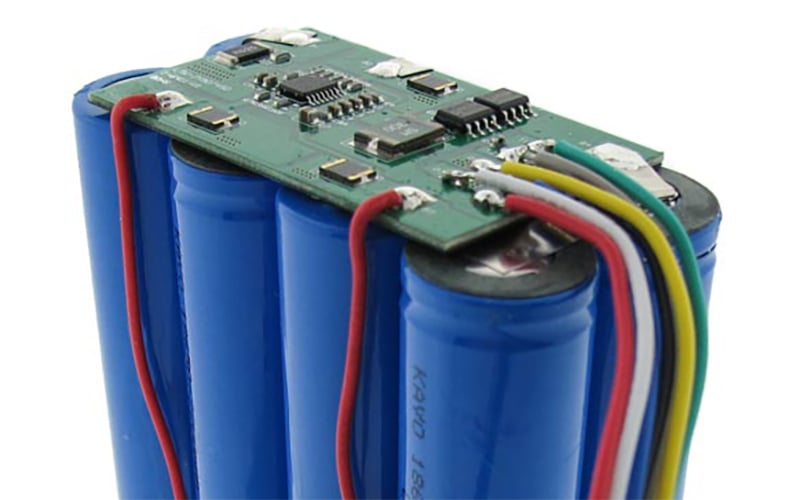
4S2P battery pack with BMS.
Programmable Protection Features
One of the many great features that fuel gauges offer is the ability to set and program protection thresholds. Many fuel gauges offer a fuse pin that can be used as a form of overcurrent protection. When the fuel gauge determines a short circuit (current threshold can be programmed), the fuel gauge will send a voltage output out of the fuse pin that will activate the fuse. Breaking this fuse will prevent the battery pack’s cells from being damaged.
While some fuel gauges don’t have a “FUSE” Pin/function, there is still a way that they can help provide protection. The fuel gauge can monitor current for the battery pack. Using an overcurrent protection IC with the fuel gauge, an overcurrent protection circuit can be made that will read the current measured by the fuel gauge and can turn off the battery pack in the event of an overcharge/discharge. This same concept can be done using an overvoltage protection IC and circuit.
Combining either a single or secondary protection circuit with a protection component such as a fuse will make the BMS able to provide multiple layers of protection for your battery pack. Thanks to the fuel gauge, the BMS will help provide a robust and reliable battery pack.
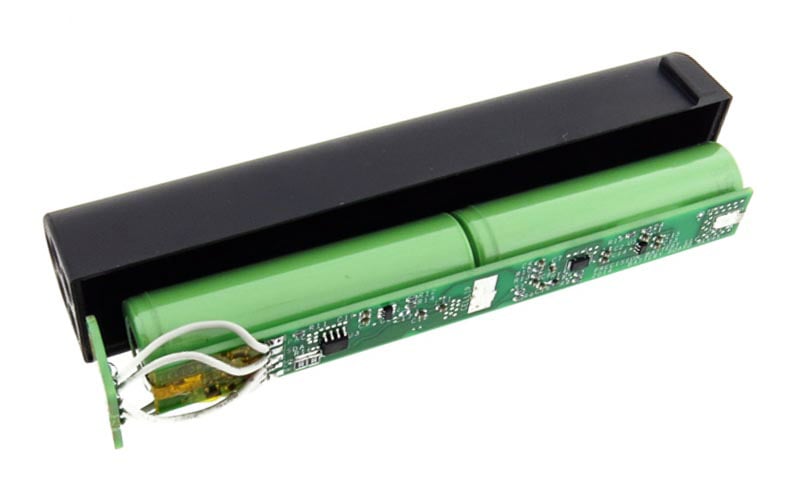
2S Battery Pack with BMS.
Reducing Power Consumption with Sleep Mode
Another feature that fuel gauges offer is the ability to make a pack energy efficient. When the fuel gauge detects that the current is below a determined programmed value, the fuel gauge will go to a “sleep” mode and will not draw power anymore.
To “wake” up the fuel gauge, a current draw higher than the sleep threshold, value can be programmed, must be drawn from the battery pack to wake the battery pack up. This sleep mode will ensure that the fuel gauge will not draw power when there isn’t a device connected to it. Ensuring that the battery pack will not draw power and drain the cells when it’s not in use. Making this battery pack “Smart” while not drawing idle power at the same time. This is perfect for applications that require a battery pack that will not be expected to be recharged over long periods of time, or if the device is not intended to draw continuous power.
Communicating Battery Data to Smart Devices
Lastly, a great feature that many fuel gauges offer is the ability to transmit data to an external device such as an MCU. Since many fuel gauges offer the ability to accurately measure voltages for each cell, total pack voltage, current draw, and temperature, there are many applications that can benefit from having this information. All that would be required to read this data is a controller that communicates with the fuel gauge’s respective SMBus communication lines.
Following the fuel gauge’s datasheet for the appropriate command to send using these SMBus communication lines, all the previously mentioned data can be read from the controller. This data from the battery pack’s fuel gauge can be used by other smart devices in a system to better understand power consumption. With this data, the system can be more efficient with other devices used to help control power consumption. All of this is thanks to the Fuel gauge’s ability to accurately sense key electrical characteristics and transmit this information to other devices.
Selecting the Right Fuel Gauge for Your Battery Pack
When designing a battery pack, it is important to consider designing a Battery Management System to ensure that the battery pack is working as efficiently and safely as possible. The most critical component when designing the BMS is the fuel gauge. With the proper fuel gauge selected for your intended battery configuration, both safety and power efficiency will be addressed.
The three critical features that the fuel gauge will have to offer for your BMS are:
- Ability to set programmable protections for your BMS
- Ability to detect when a device is in use and set to “sleep” to limit current draw when not in operation.
- Transmit data to external devices regarding key electrical characteristics such as Pack Voltage, Cell Voltages, and Current Draw.
Summary
A battery management system is only as effective as the information it receives, and the fuel gauge serves as the primary source of that information. Beyond simply reporting remaining battery capacity, today's fuel gauges continuously monitor voltage, current, temperature, and overall battery health while working alongside protection circuitry to prevent conditions that could shorten battery life or create safety risks.
Selecting the proper fuel gauge for the cell chemistry and configuration allows engineers to build battery packs that are safer, more efficient, and capable of delivering reliable performance throughout their service life.
Whether the application is a portable medical device, industrial tool, robotics platform, or consumer product, investing time in selecting the right fuel gauge early in the design process pays dividends in battery longevity, system performance, and overall product reliability.
Key Takeaways
- The fuel gauge is one of the most important components of a Battery Management System because it monitors battery conditions and supports safe charging, discharging, and overall pack operation.
- Fuel gauge selection should match the battery pack's cell configuration and chemistry to ensure accurate monitoring and proper system functionality.
- Programmable protection thresholds allow the fuel gauge to work with fuses and protection circuits to guard against overcurrent, overvoltage, short circuits, and other fault conditions.
- Sleep mode functionality helps minimize idle power consumption, extending storage life and improving efficiency for battery packs that spend long periods inactive.
- Communication interfaces such as SMBus allow the fuel gauge to provide real-time battery data to external controllers, enabling smarter power management and improved system performance.