



When requesting a printed circuit board (PCB) quotation or placing an order, it is important to communicate all product requirements as clearly and completely as possible. Even seemingly minor omissions can create confusion during quoting, affect supplier assumptions, and ultimately impact cost, lead time, or manufacturability.
A standardized set of PCB fabrication notes helps ensure that requirements are communicated consistently from the beginning of the quoting process through production. This reduces misunderstandings and helps suppliers quote and manufacture the board to the same expectations.

Incomplete Requirements Can Create Cost and Schedule Risks
PCB fabricators develop quotations based on the information provided at the time of the request. Problems often arise when additional requirements are introduced after pricing, delivery commitments, and purchase orders have already been established.
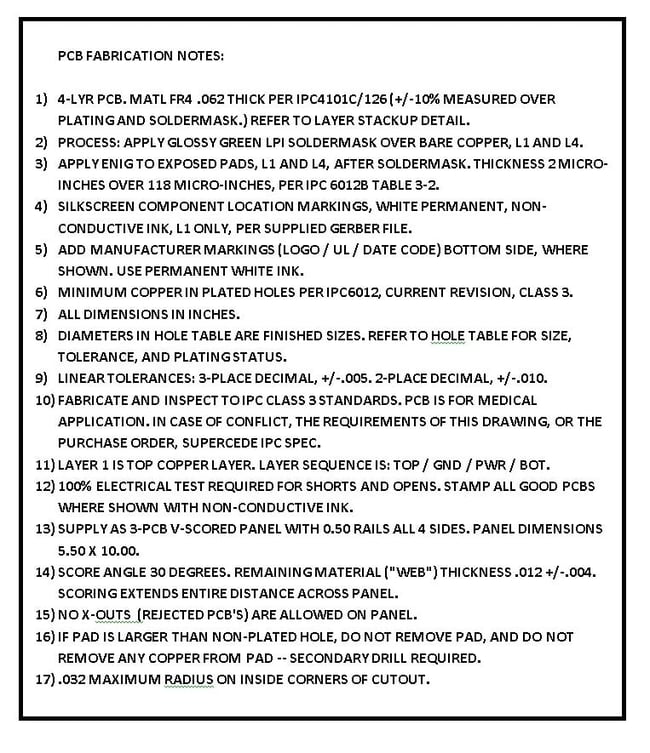 Example of PCB Fabrication Notes
If newly provided information affects manufacturing processes, materials, or fabrication requirements, the supplier may need to revise pricing, delivery schedules, or both. These changes can interrupt progress and require additional coordination between engineering, purchasing, and manufacturing teams before work can continue.
Providing complete documentation up front helps avoid these disruptions.
Why Consistent Documentation Improves PCB Quotations
Accurate quotations depend on accurate requirements.
When you clearly document all PCB requirements from the start, suppliers can evaluate the same information and develop quotations based on a common set of expectations. This is particularly important when requesting competitive bids from multiple PCB manufacturers.

Example of Fabrication Notes in Drawing

Without standardized fabrication notes, different suppliers may interpret missing information differently. As a result, quotations that appear to be for the same PCB design may actually be based on different manufacturing assumptions.
For purchasing teams, this makes meaningful supplier comparisons difficult.
The Problem with Leaving Requirements Open to Interpretation
Incomplete design documentation forces PCB manufacturers to make assumptions about requirements that have not been explicitly stated.
Because manufacturers have different capabilities, preferences, and internal processes, those assumptions may vary significantly from one supplier to another. Even when suppliers are acting in good faith, missing information can result in different interpretations of how the circuit board should be manufactured.
These assumptions can affect:
- Quoted pricing
- Production lead times
- Material selection
- Manufacturing processes
- Overall product requirements
The result may be a noticeable difference between supplier quotations, even though each supplier received the same PCB design files.
Material and Surface Finish Assumptions Can Significantly Affect Cost
Laminate material and surface finish as two areas where supplier assumptions can have a substantial effect on quoted pricing.
When these requirements are not clearly defined, suppliers may select different options during the quoting process. Because these choices can significantly influence manufacturing costs, quotations may vary considerably even when the design itself remains unchanged.
Clearly documenting fabrication requirements helps ensure that all suppliers are evaluating the same product configuration.
Avoid Purchasing Decisions Based Solely on Price
The lowest quotation is not always based on the same assumptions as competing bids.
If fabrication notes do not clearly identify the required materials, finishes, or manufacturing requirements, a lower quote may have been generated using less costly assumptions than intended. Differences may not be discovered until later in the process, when requirements are reviewed in greater detail.
At that point, pricing adjustments, lead-time changes, or both may be required before production can move forward.
By including standard PCB fabrication notes with every quotation request and order, purchasing and engineering teams can reduce the risk of misunderstanding and improve confidence that suppliers are quoting the same set of requirements.
Standard Fabrication Notes Help Create More Accurate Quotes
Standard PCB fabrication notes provide a consistent method for communicating design requirements, manufacturing expectations, and customer standards. Clear documentation reduces ambiguity, supports more accurate quotations, and helps prevent delays caused by revised assumptions after an order has been released.
For both engineering and procurement teams, the goal is straightforward: ensure that all suppliers are evaluating the same PCB requirements so pricing, lead times, and manufacturing expectations can be compared accurately.
Summary
Before you find yourself making your printed circuit board purchasing decision based solely on the lowest cost, consider what may be omitted from your quote. Pricing for the lowest bid may not have included material or process that meets your standards if the circuit board supplier did not know about the requirement from the information they initially received.
When discrepancies are discovered, progress is halted until the resulting changes to circuit board price and/or lead time on your order are worked out. To lower your risk, always send standard PCB fabrication notes with every order.
Key Takeaways
- Complete Documentation Prevents Delays: Clearly stating all PCB requirements upfront ensures accurate quotes and prevents production halts caused by mid-order changes or miscommunications.
- Assumptions Lead to Inconsistencies: Incomplete specifications leave room for interpretation, resulting in different pricing, materials, or finishes between suppliers, even for the same design.
- Fabrication Notes Enable Accurate Comparisons: Providing standardized fabrication notes allows for true apples-to-apples comparisons across supplier bids, improving confidence in your purchasing decision.
- Avoid the Lowball Trap: Some vendors may offer artificially low pricing by assuming minimal specs, only to raise costs later. Detailed requirements reduce the risk of misleading quotes.
- DFM Checks Catch Problems Early: If you’re unsure about your design’s manufacturability, submitting a free Design for Manufacturability (DFM) check can help identify issues before quoting or production.